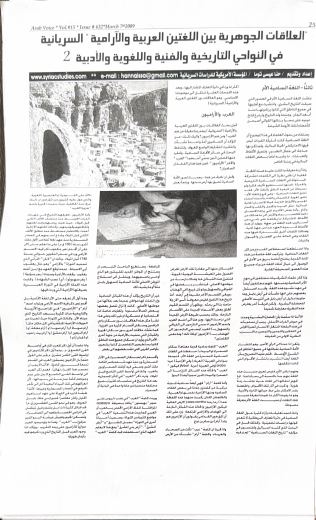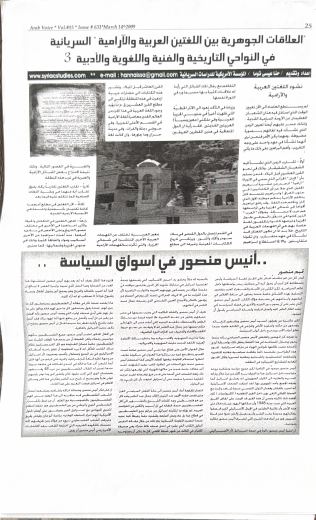
اللغة الآرامية السريانية
The Aramaic-Syriac Language
العدد 592 — ٣١ أيار ٢٠٠٨ — May 31, 2008
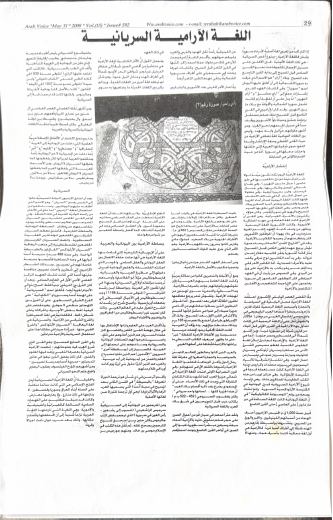
A survey of Aramaic, the ancient tongue of Syria and Lebanon, tracing its spread from Persia to Egypt, its use as the language of Christ, and its survival in Tur Abdin and Maaloula. It highlights Syriac's role as the bridge that carried Greek philosophy and medicine into Arabic. This column ran without a byline; the following issue credited its preparation to Hanna Issa Touma.
دور المراكز السريانية في تفاعل العرب والمسلمين الحضاري ١
The Role of Syriac Centers in the Civilizational Interaction of Arabs and Muslims, Part 1
العدد 593 — ٧ حزيران ٢٠٠٨ — June 7, 2008
The first installment of a study by Dr. Hussein Qasim al-Aziz on how Syriac scholarly centers helped Arabs and Muslims engage with world civilization in the medieval era. It contrasts pre-Islamic Arabia's isolation with the developed Byzantine and Sasanian lands, and introduces the translation movement through which Syriac scholars transmitted Greek learning into Arabic.
دور المراكز السريانية في تفاعل العرب والمسلمين الحضاري ٢
The Role of Syriac Centers in the Civilizational Interaction of Arabs and Muslims, Part 2
العدد 594 — ١٤ حزيران ٢٠٠٨ — June 14, 2008
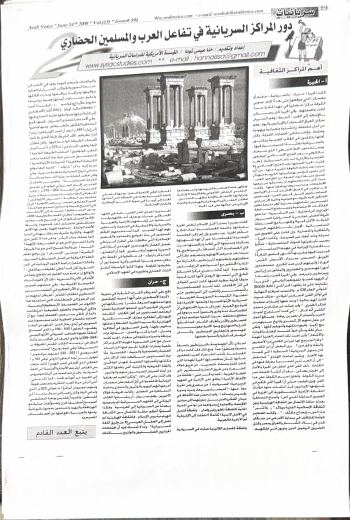
Continuing Dr. Hussein Qasim al-Aziz's study, this installment profiles the great pre-Islamic cultural centers: al-Hira, capital of the Lakhmids; Bosra of the Ghassanids; pagan-Sabian Harran; and Edessa (Urfa), cradle of Syriac Christianity. It shows how each city's Christian and Aramaic-speaking communities later became the conduit of Hellenistic learning to the young Islamic culture.
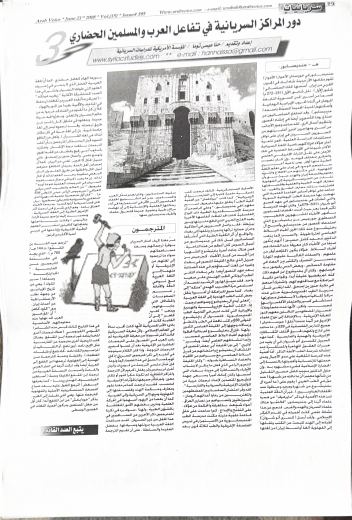
دور المراكز السريانية في تفاعل العرب والمسلمين الحضاري ٣
The Role of Syriac Centers in the Civilizational Interaction of Arabs and Muslims, Part 3
العدد 595 — ٢١ حزيران ٢٠٠٨ — June 21, 2008
Dr. Hussein Qasim al-Aziz's third installment centers on Gundeshapur, the Sasanian medical academy where Syriac, Greek, Persian, and Indian learning merged, producing the Bukhtishu dynasty of Abbasid court physicians. It then opens a survey of the translators, from Sergius of Reshaina, pioneer of Greek-to-Syriac medical translation, to Ibn al-Muqaffa, translator of Kalila and Dimna.
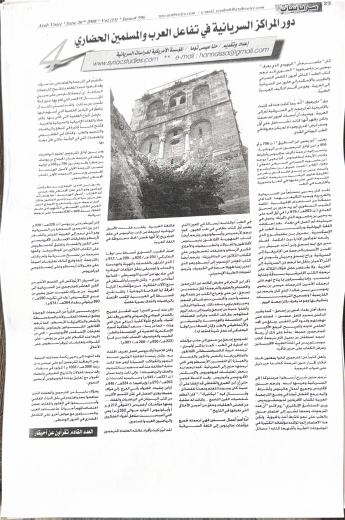
دور المراكز السريانية في تفاعل العرب والمسلمين الحضاري ٤
The Role of Syriac Centers in the Civilizational Interaction of Arabs and Muslims, Part 4
العدد 596 — ٢٨ حزيران ٢٠٠٨ — June 28, 2008
The final installment of Dr. Hussein Qasim al-Aziz's study profiles the great translators of the Abbasid age, above all Hunayn ibn Ishaq, whose renderings of Galen, Hippocrates, Aristotle, and Plato passed through Syriac into Arabic. It also covers Qusta ibn Luqa, Thabit ibn Qurra of Harran, and later Syriac Orthodox translators such as Yahya ibn Adi.
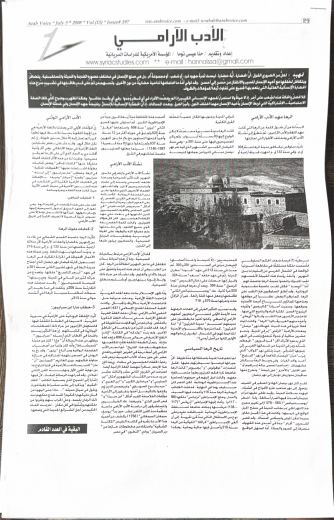
الأدب الآرامي ١
Aramaic Literature, Part 1
العدد 597 — ٥ تموز ٢٠٠٨ — July 5, 2008
The opening of a series on Aramaic literature, beginning with Edessa (Urfa), the city regarded as its cradle: its founding, rivers and floods, and political fortunes under Parthians, Romans, and Muslims. The article then surveys the rare surviving pagan Aramaic writings, including tomb inscriptions, the royal archives of Edessa's kings, and the letter of Mara bar Serapion.
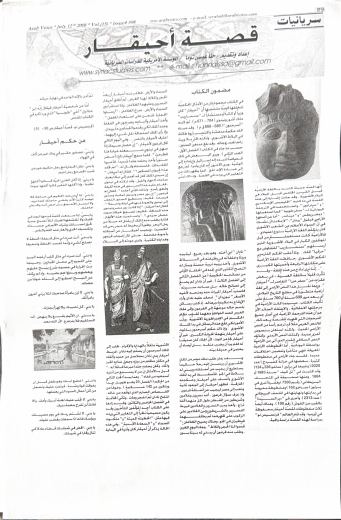
قصة أحيقار
The Story of Ahiqar
العدد 598 — ١٢ تموز ٢٠٠٨ — July 12, 2008
An introduction to the ancient Aramaic tale of Ahiqar, the wise counselor of the Assyrian kings Sennacherib and Esarhaddon, betrayed by his adopted nephew Nadan and vindicated through his legendary contest of riddles at Pharaoh's court. The article reviews the story's manuscripts and translations, drawing on Francois Nau's study, and closes with a selection of Ahiqar's proverbs.
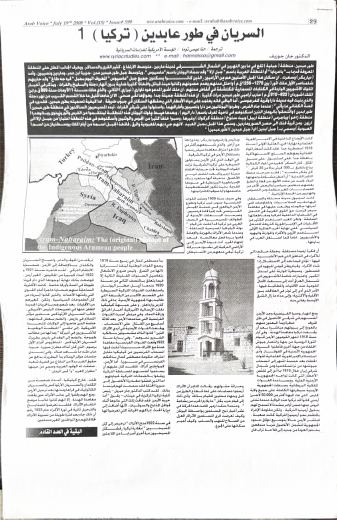
السريان في طور عابدين ( تركيا ) ١
The Syriacs of Tur Abdin (Turkey), Part 1
العدد 599 — ١٩ تموز ٢٠٠٨ — July 19, 2008
The first part of a study by Dr. John Joseph, translated by Hanna Issa Touma, on the Syriac Christians of Tur Abdin, the mountainous heartland in southeastern Turkey. After describing the region's Aramean origins and the legend behind its name, it recounts the turmoil after World War I: Armenian and Kurdish national ambitions, Kemalist resistance, and the Christian minorities caught in between.
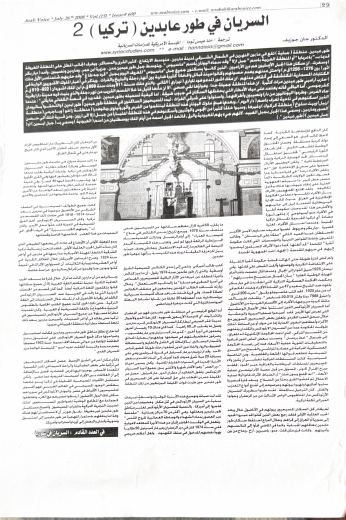
السريان في طور عابدين ( تركيا ) ٢
The Syriacs of Tur Abdin (Turkey), Part 2
العدد 600 — ٢٦ تموز ٢٠٠٨ — July 26, 2008
Continuing Dr. John Joseph's study in Hanna Issa Touma's translation, this part covers the 1925 Kurdish revolt and the deportations and violence that struck Syriac Orthodox villagers, including the expulsion of the patriarch from Deyrulzafaran monastery. It then surveys the community's surviving strongholds, the monasteries of Deyrulzafaran and Mor Gabriel, Midyat, and Mardin, and the emigration clouding Tur Abdin's future.
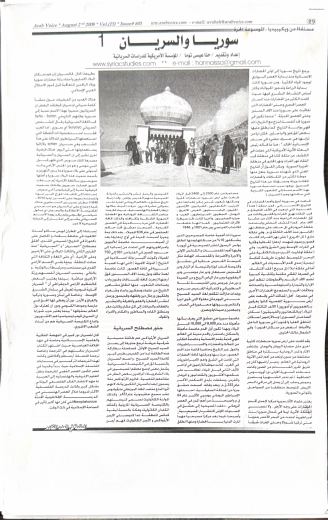
سوريا والسريان ١
Syria and the Syriacs, Part 1
العدد 601 — ٢ آب ٢٠٠٨ — August 2, 2008
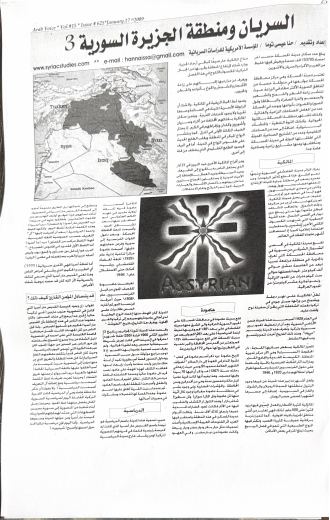
Drawing on the Arabic Wikipedia, this installment surveys Syria's deep past, from Mari, Ugarit, Ebla, and the Arameans to Damascus, among the world's oldest continuously inhabited cities, and its importance to Christianity. It then examines the origins of the name Syriac, competing theories about the term, modern debates over Syriac identity, and the community's celebrated role in the Abbasid translation movement.
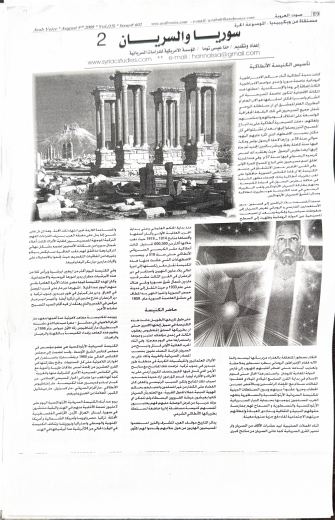
سوريا والسريان ٢
Syria and the Syriacs, Part 2
العدد 602 — ٩ آب ٢٠٠٨ — August 9, 2008
The second installment of a survey of Syriac history, drawn from the Arabic Wikipedia and presented by Hanna Issa Touma. It covers the founding of the Church of Antioch, the pacts made with early Muslim rulers, the massacres of 1914-1919, the patriarchate's moves from Antioch to Damascus, and the Syriac Orthodox Church today, with its dioceses, monasteries, and roughly two million faithful.
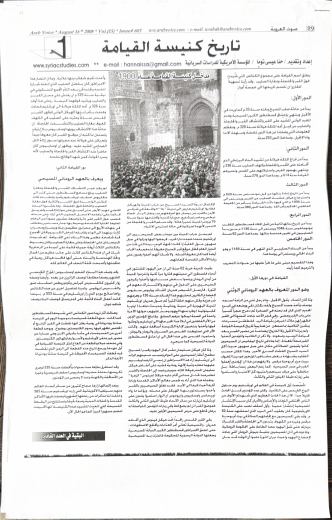
تاريخ كنيسة القيامة ١
The History of the Church of the Holy Sepulchre, Part 1
العدد 603 — ١٦ آب ٢٠٠٨ — August 16, 2008
Opening a serialized history that divides the Church of the Holy Sepulchre's story into five eras, this installment covers the first two: from the crucifixion and burial of Christ through Hadrian's pagan temple over the tomb, then Helena's discovery of the tomb, Golgotha, and the Cross in 326 and Constantine's magnificent basilica, described through early pilgrim accounts.
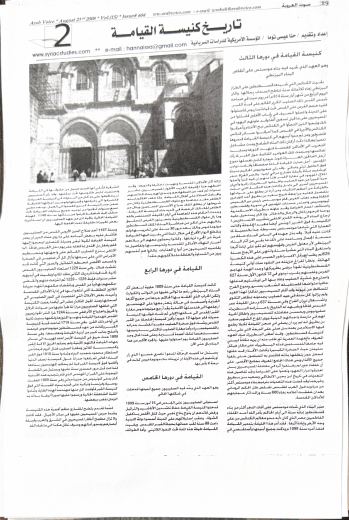
تاريخ كنيسة القيامة ٢
The History of the Church of the Holy Sepulchre, Part 2
العدد 604 — ٢٣ آب ٢٠٠٨ — August 23, 2008
The series concludes with the church's later eras: the Persian destruction of 614 and Modestus's rebuilding, Caliph Umar's respectful entry into Jerusalem, the demolition ordered by the Fatimid caliph al-Hakim, Constantine Monomachos's reconstruction, the Crusaders' unification of the shrines under one dome in 1149, Saladin's clemency, and the fires, earthquakes, and restorations that shaped the building down to 1869.
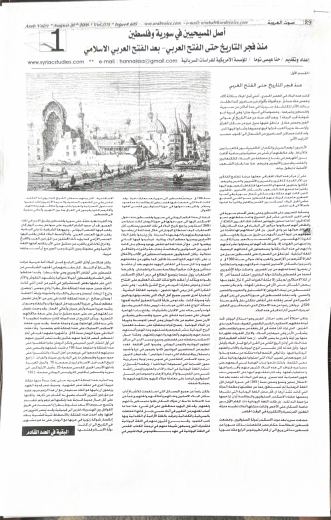
أصل المسيحيين في سورية وفلسطين ١
The Origin of the Christians of Syria and Palestine, Part 1
العدد 605 — ٣٠ آب ٢٠٠٨ — August 30, 2008
First installment of a historical study tracing the peoples of Syria and Palestine from the Stone Age to the Arab conquest. It surveys the Semitic migrations, including the Arameans, Phoenicians, and Hebrews, and the successive Hittite, Egyptian, Assyrian, Persian, and Greek dominations, with special attention to Hellenization under Alexander and the Arab kingdoms of the Nabataeans and Palmyra.
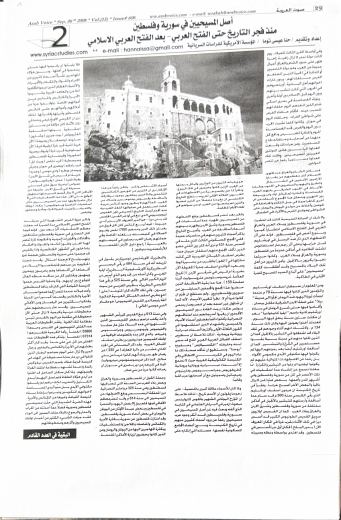
أصل المسيحيين في سورية وفلسطين ٢
The Origin of the Christians of Syria and Palestine, Part 2
العدد 606 — ٦ أيلول ٢٠٠٨ — September 6, 2008
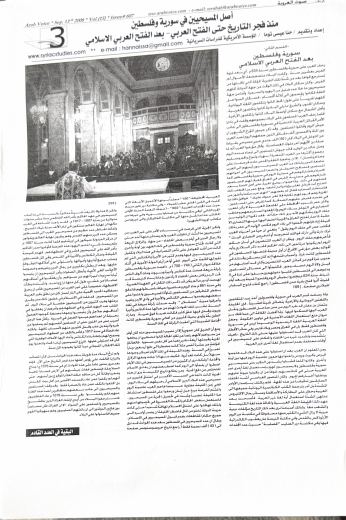
The study continues with the Christian Arab kingdoms of the Ghassanids and Lakhmids and the spread of Christianity across Syria, Palestine, and Arabia before Islam. It documents Arab bishops at the ecumenical councils, Arab patriarchs of Jerusalem, monasteries that prayed in Arabic, and the sixty bishoprics of the region, before recounting the devastating Persian invasion of 614.
أصل المسيحيين في سورية وفلسطين ٣
The Origin of the Christians of Syria and Palestine, Part 3
العدد 607 — ١٣ أيلول ٢٠٠٨ — September 13, 2008
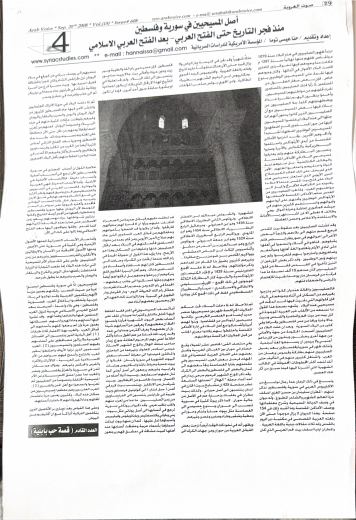
This installment follows the Christians of Syria and Palestine after the Islamic conquest of 634: Christian Arab tribes who sided with the conquerors, the shift from Greek and Aramaic to Arabic as church and daily language, the burdens of the jizya tax, earthquakes and famines, the persecutions of the Fatimid caliph al-Hakim, and the Seljuk invasion on the eve of the Crusades.
أصل المسيحيين في سورية وفلسطين ٤
The Origin of the Christians of Syria and Palestine, Part 4
العدد 608 — ٢٠ أيلول ٢٠٠٨ — September 20, 2008
Concluding the series, this part examines the Crusader era's harsh treatment of native Orthodox Christians, Saladin's restoration of the holy places to them, and the assimilation of Crusader remnants. It traces notable Arab clergy and the varied genealogies of Christian families, concluding that the region's Christians, of Aramean, Arab, and Greek stock, are Arab by language, culture, and homeland.
بيرم وتسبين
Pyramus and Thisbe (A Babylonian Love Story)
العدد 609 — ٢٧ أيلول ٢٠٠٨ — September 27, 2008
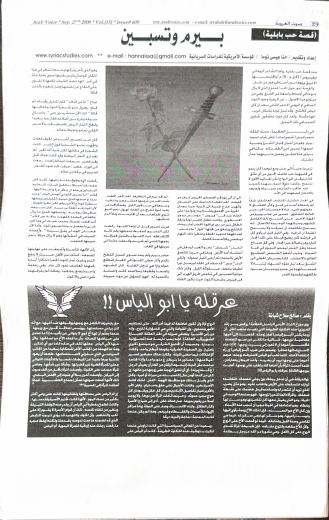
A retelling of the Babylonian legend of Pyramus and Thisbe as recounted by the Roman poet Ovid: two young lovers in Babylon, kept apart by their families, whose tragic deaths beneath a mulberry tree turned its white fruit forever red. The page also carries a companion piece by Saleh Salah Shabaneh on a Jordanian folk proverb about a wife's loyalty to her husband.
الآراميون الشعب السامي الثالث الرئيسي
The Arameans: The Third Major Semitic People
العدد 610 — ٤ تشرين الأول ٢٠٠٨ — October 4, 2008
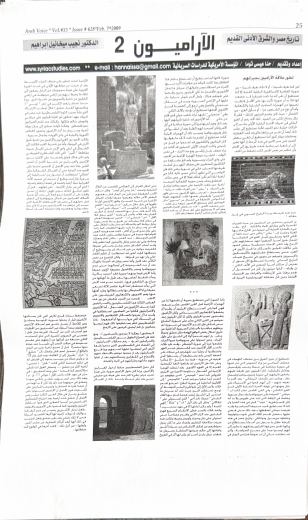
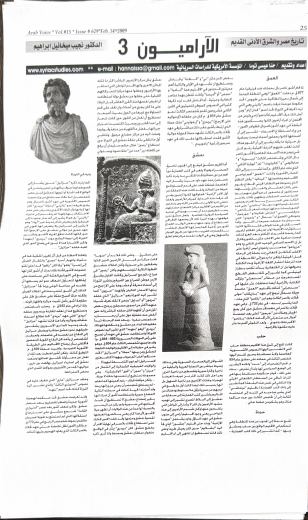
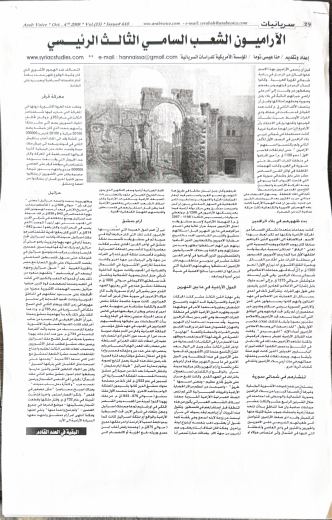
First installment of an excerpt from Philip Hitti's History of Syria, Lebanon and Palestine on the Arameans, the third great Semitic migration out of the desert. It traces their emergence along the middle Euphrates, their kingdoms in Mesopotamia and at Damascus, their long rivalry with the Hebrew kingdoms, the Battle of Qarqar, King Hazael's conquests, and the Assyrian destruction of Damascus in 732 BC.
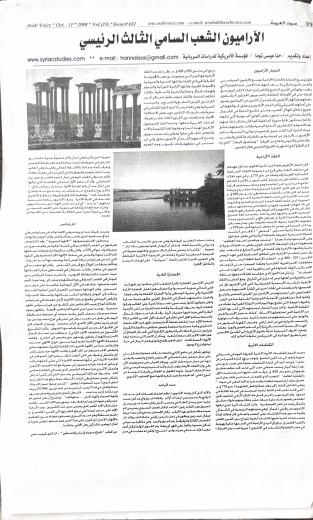
الآراميون الشعب السامي الثالث الرئيسي (تتمة)
The Arameans: The Third Major Semitic People (Conclusion)
العدد 611 — ١١ تشرين الأول ٢٠٠٨ — October 11, 2008
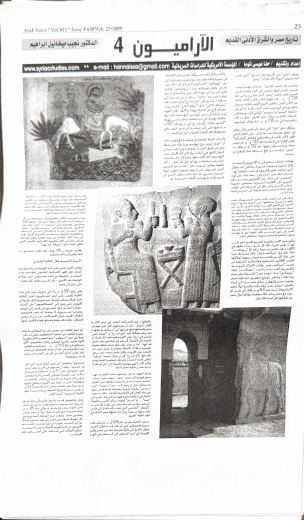
Concluding the excerpt from Philip Hitti's History of Syria, Lebanon and Palestine, this installment turns from politics to civilization: Aramean caravan trade, the extraordinary spread of the Aramaic language, the tongue of Jesus, and its alphabet across Asia, the oldest Aramaic inscriptions, and Aramean religion centered on the storm god Hadad and the goddess Atargatis.
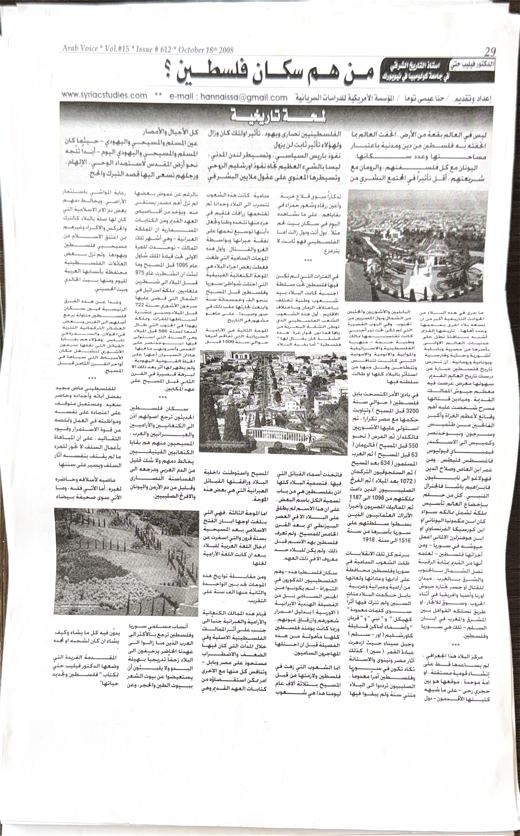
من هم سكان فلسطين؟
Who Are the Inhabitants of Palestine?
العدد 612 — ١٨ تشرين الأول ٢٠٠٨ — October 18, 2008
Philip Hitti's introduction to the book Palestine and the Renewal of Its Life, presented here by the column. The Columbia University historian surveys Palestine's outsized religious and civilizational influence, the succession of empires that ruled it, and the Canaanite, Aramean, Hebrew, and Arab waves that shaped its modern population, concluding that today's Palestinians descend from all of them.
التاريخ
History, Part 1
العدد 613 — ٢٥ تشرين الأول ٢٠٠٨ — October 25, 2008
An introductory essay on history as a discipline: its definition, subject matter, and importance for awakening national feeling. It explains historians' sources, contemporary writings, oral tradition, and ancient monuments, and outlines the standard divisions of time, from the prehistoric Stone, Bronze, and Iron Ages through the ancient, medieval, and modern eras, closing with the branches of civil, religious, and natural history.
التاريخ ٢
History, Part 2
العدد 614 — ١ تشرين الثاني ٢٠٠٨ — November 1, 2008
The second part of the essay on history surveys the world's first historians, from Herodotus to the great Arab chroniclers such as Ibn Khaldun, with special attention to famous Syriac historians, Bar Hebraeus and Patriarch Michael the Great and their works. It also covers dating systems used by different peoples, the modern transformation of history into a science, and classic sayings in praise of history.