هذه قصة حب بابلية رواها الشاعر الروماني اوفيديوس ( 43 ق.م - 18 م ) واقتبسها الاغريق ورووها بين أساطيرهم عن بابل . والقصة تدور حول الحب الممنوع الذي لا يزال ممنوعا في أوساط واسعة من الشرق وهي من ميتولوجيا الاصول - عن كيفية وجود التوت الشامي او الرومي الاحمر القاني بعد ان كان ابيض كالثلج . وقد تبدل لونه بتشكل غريب . انها مأساة . ولقد كان موت عاشقين شابين السبب في ذلك التبديل.
في بابل العظيمة ، مدينة الملكة سميراميس ( شمورامات ) عاش شاب اسمه ، بيرم ، وهو من أجمل فتيان الشرق وصبية اسمها ( تسبين ) من ألطف بناته . سكنا في بيتين متلاصقين يفصل ما بينهما جدار مشترك.
ترعرعا جنباً الى جنب ومع نموهما كان ينمو في قلبيهما حب عاصف اقوى من أي عائق . كانا يتوقان الى الزواج لكن تقاليد الأهل لا تسمح . وكلما حاولا اخماد حبهما تأججت ناره . فالحب دائما يجد سبيله ولم يعد بالامكان فصلهما الى الأبد.
في الجدار المشترك اكتشف العاشقان شقاً لم يلحظه أحد من قبل وكأن العشاق لا يفوتهم شيء . تبادلا همسات الحب عبر الحائط المشقوق . تسبين من جانب وبيرم من الجهة الاخرى . حتى أصبح ذلك الفاصل المشؤوم وسيلتهما الوحيدة للاتصال . انه يسمح للكلمات ان تخرقه ولا يسمح للقبلة ان تمر فيه . وفي الليل قبل ان يأوي كل الى فراشه كان يطبع قبلة على ذلك الجدار البارد ويمر بخياله عبر الجدار . وفي كل صباح عندما يطل الفجر ليمحو النجوم في قبة السماء . وتذيب أشعة الشمس الصقيع العالق بالاعشاب . كانا يسرعان الخطى الى الشق بعد ليل ملؤه السهاد ليتبادلا همساتهما من جديد ويندبان سوء طالعهما وقسوة القدر.
الى أن أتى يوم قرر العصفور الحبيس ان يفر من قفصه . لقد اتفقا ذات ليلة على التسلل والهرب خارج المدينة الى البرية حيث يجدان الحرية من المجتمع وتقاليده وتواعدا على اللقاء عند قبر " فينوس " مؤسس نينوى الاسطوري . وكانت تظلل القبر توتة وارفة الظلال تبرز من بين اوراقها الخضر ثمار بيضاء كالثلج ويتدفق من تحتها " فوار " ماء عذب . لقد تلهفا لتنفيذ الخطة وانتظرا ذلك النهار لينقضي وكأنه سنة كاملة.
انحدر " شمش " نحو الغرب ليدخل في أحشاء أمه الأرض . ويختفي حيث تلتصق الأرض بالسماء ثم أرخى الليل سدوله . ولكن البدر " سين " قد صعد في الجلد ليرسل نورا لطيفاً يخفف حلوكة الليل . وكان ذلك مواتياً لتسبين كي تتلمس طريق الهرب الى قبر فينوس وشجرة التوت حيث يكون اللقاء .
لم تجد بيرم في انتظارها . لقد تأخر ، قلقت ، شدد الحب من عزيمتها فتشجعت وانتظرت وحدها في سكون الليل . وفجأة لمحت من بعيد لبوة تخرج من الغابة تهرول نحو النبع لتروي ظمأها بعد أن افترست وملأ الدم شدقيها.
هربت تسبين قبل ان تراها اللبوة . ركضت لكن النسيم أسقط منديلها ولم تأبه لالتقاطه . مرت اللبوة بالمنديل فمزقته بفمها المدمى ثم شربت وقفلت عائدة الى عرينها في الغاب.
حضر بيرم ولم يجد سوى المنديل الملطخ بالدم وآثار خطى اللبوة في الغبار فتطلع حوله واذا هي تدخل الغابة . كان المشهد واضحاً وفظيعاً وخلاصته كانت واضحة بالنسبة له . فهو المسؤول عن موت حبيبته وهو الذي تأخر وتركها وحدها ننتظر⟨؟⟩ في هذا المكان الموحش وليس بقريها⟨؟⟩ سوى بقايا جثة في قبر . انها غضة الشباب لكنها لا تقوى على الدفاع عن نفسها وصار شعوره بالذنب قاتلا.
صاح " انا من قتلك " لملم المنديل وقبله ثم قبله ، وهرول نحو شجرة التوت وخاطبها قائلاً " انك الآن ستشربين دمي " . واستل سيفه وغرزه بين أضلاعه ففار دمه بعيدا ولطخ الثمار البيض فاصطبغت بالاحمر القاني ثم هو يتخبط بدمائه.
كان حب تسبين أشد من الخوف فعادت واتجهت نحو الشجرة فوق القبر . كانت الشجرة في مكانها لكن شيئا قد تغير . لم تعد ترى الثمار البيضاء وقد كانت هناك قبل وقت قصير . سمعت انينا فارتعدت . رجعت الى الوراء . خافت . حدقت تحت ضوء القمر . انه بيرم في بركة من دمائه.
ركضت اليه وطوقته بذراعيها . لقد كان جلده باردا مبللا بالعرق قبلت شفتيه الباردتين ورجته ان ينظر مرة واحدة اليها . قالت " انا تسبين كلمني أتوسل اليك " وعند سماع اسمها فتح عينيه الثقيلتين ورمقها بنظرة الوداع الأخير ولم تكن نظرة طويلة . لأن الموت قد اطفأ نور عينيه . كان سيفه ساقطاً بجانبه . ومنديلها الممزق ما يزال عالقاً في قبضته ففهمت بدقة دون كلام " أنت قتلت نفسك بسبب حبك لي وما كان شيء ليفصل بيننا سوى الموت . وأما الآن فحتى الموت لن يفرق بيننا " . وأغمدت السيف في أحشائها وهو لا يزال مبللاً بدم حبيبها المتجمد.
رأت الآلهة المأساة وأشفقت على نهايتها المفجعة . كذلك ندم الأهل حيث لا ينفع الندم وبقيت ثمار التوت الحمراء تذكاراً أبديا لحبهما العاصف تعود كل عام . وفي زجاجة واحدة وضع رمادهما ، وهكذا لم يفرقهما شيء حتى ولا الموت.
عرقله يا ابو الياس !!
بقلم : صالح صلاح شبانة
روى مؤرخ التراث الأردني الراحل العلّامة ( روكس بن زائد العزيزي) هذه الحكاية الطريفة التي ذهبت مذهب المثل . أن زوجا يكنى (أبو إلياس) أهان زوجته . فذهبت إلى أخيها مغاضبة لزوجها . شاكية ما تلقى من سوء المعاملة . فأقسم أخوها أن لا تعود إلى بيت زوجها . إلا إذا جاء لاسترضائها صاغرا . وصمم على ضرب (أبو إلياس) إن رآه انتقاماً لأخته . فلما ذهب أبو الياس لاسترضاء زوجته . هجم أخوها على زوجها يريد أن يضربه . وأخذ الرجلان يتعاركان . فلما أحست المرأة بأن أخاها كاد يتغلب على زوجها . أهابت بزوجها قائلة) :عرقله يا ابو الياس!!!!
(والعرقلة هي أن تدخل رجلك بين رجلي خصمك . فتفقده توازنه فتسقطه على الأرض وتتغلب عليه . وهو مثل يضرب للذي تريد أن تنتصر له وتساعده فيدل خصمك على نقطة ضعفك . والمرأة دائما تتحيز لزوجها . فهو سندها الوحيد في الحياة . وهو الذي يعيش معها كل تفاصيلها وهو ستر لها وغطاء . وهو امتدادها في الحياة مجرد أن تنجب منه الأبناء . وإن كان الأخ هو السند . فإن لذلك الأخ زوجة يأوي إليها يتوسد ذراعيها . وهو سكن لها وهي سكن له . فيما هي تقاسي وحدة الليل وعذاباته . فيما لو قدمت الأخ على الزوج . ولأن للأخ مقامه وللزوج مقامه . فإن طبيعة المرأة تقديم الزوج على كل الأهل . وهي مأمورة من الله عز وجل بطاعة الزوج أولا وان تكون خاضعة له فيما أمر الله . حتى تستقيم الأمور وتستوي . وان القوامة والتي هي المسؤولية للزوج . وإنه هو رأس الأسرة . وتعتلي صورته في دفتر العائلة العبارة الشهيرة (رب العائلة) . فإنه يحب ممارسة هذه المسؤولية بجدارة . وخصوصا أن المجتمع الشرقي هو مجتمع ذكوري بامتياز . وإن السفينة الشرقية يقودها قبطان واحد . وكانت الإختلالات فيما مضى قليلة . وكانت هناك مضامين لسير الحياة منها) : حصانين ما بنربطن⟨؟⟩ عَ مذود واحد) و(إذا الجاجه صاحت مثل الديك إذبحوها) وكان من العار أن يعيش الرجل (عَ قفا مِرته) . أي أن تنفق الزوجة على زوجها من مالها . إن كان من كدها أومن مال إكتسبته من ميراث أو غيره . وكان الذي يقبل بذلك هو ساقط الهمة . النذل . لذلك كانت الأسرة بخير . وكانت الأجيال على خلق واحترام . وكان الأب والأم يراعيان تفاصيل الأبناء ويصوبان كل خلل ويقومان كل عوج مجرد حدوثه . وحينما تخلت المرأة عن دورها . ولا يوجد أصلاً من يقوم بدورها . صار هناك خلل . أدى إلى ضياع الأسرة وكثر الطلاق . وازداد الانحراف وصار على الدولة زيادة مراكز الإيواء للأحداث واللقطاء وغيرهم . وهذا لم يكن عندما كانت الدجاجة دجاجة والديك ديكا
وبعيدا عن المعاني السياسية التي كانت تراودني عندما فكرت بتوظيف هذه الحكاية الطريفة . كانت أم الياس على حق بتحيزها الكامل مع زوجها ووقوفها ضد أخيها . مع أنه كان يراعي مصلحتها . ويؤسس لعلاقة أقوى مع زوجها . عندما يعلم أن لها أخ قوي لا يتوانى عن تأديبه إذا ما اعتدى على حياضها المصانة . وأن ما فعله الأخ هو لصالحها . ولأن حبها لأبي الياس جعلها تقف في صفه تماما دون أي تفكير . وهذا ما فهمته من الجانب الآخر للحكاية بعيدا عن الجانب السياسي الذي حفزني لاستخدامها . طامعا أن يعود للأسرة دورها بعيدا عن المريضات نفسيا والمتأزمات اللواتي جعلن للمرأة قضية غير قضيتها . وشأنا غير شأنها . وهاهي المرأة حصلت على الكوتا . وأوصلت المرأة بأقل من ألف صوت إلى البرلمان . وأوصلت أخرى بلا أي صوت إلى المجلس البلدي . ذلك لأنها أعطت صوتها لممثل إجماع العشيرة . فماذا أضافت المرأة إلى المسيرة ؟؟
إن أم الياس على بساطتها وتلقائيتها كانت على وعي أكثر بكثير من نساء اليوم . لأنها كانت تحترم الأسرة وتقدسها . وكانت تطمح بفطرة أبي الياس أن يقدر هذه الوقفة النبيلة ويتغير من تلقاء نفسه . ذلك أن قوام الأسرة لا يقوم إلا على الحب والتفاهم . وأن الخوف والتهديد قد يؤدي نتيجة النابض الذي قد تضمنه ما دمت تدوسه بقدمك ولكنه (يفط مجرد ما رفعت رجلك عنه (وتحية للمرأة البدوية أم الياس.
This is a Babylonian love story told by the Roman poet Ovid (43 BC – 18 AD), which the Greeks borrowed and recounted among their myths about Babylon. The story turns on forbidden love — a love still forbidden across wide reaches of the East — and it belongs to the mythology of origins: an account of how the Levantine, or Roman, mulberry came to be a deep blood-red after having been white as snow. Its color changed in a strange fashion. It is a tragedy, and the death of two young lovers was the cause of that transformation.
In great Babylon, the city of Queen Semiramis (Shammuramat), there lived a young man named Pyramus, one of the fairest youths of the East, and a girl named Thisbe, one of its loveliest daughters. They dwelt in two adjoining houses, separated by a shared wall.
They grew up side by side, and as they grew, a tempestuous love — stronger than any obstacle — grew within their hearts. They longed to marry, but the customs of their families would not allow it. And the more they tried to smother their love, the more fiercely its fire blazed. For love always finds its way, and it was no longer possible to keep them apart forever.
In the shared wall the two lovers discovered a crack that no one had ever noticed before — as though nothing escapes lovers. They exchanged whispers of love through the fissured wall, Thisbe on one side and Pyramus on the other, until that ill-fated partition became their only means of contact. It let their words pass through but would not let a kiss cross it. At night, before each retired to bed, one would press a kiss upon that cold wall and pass in imagination through it. And every morning, when the dawn broke to erase the stars in the dome of the sky, and the rays of the sun melted the frost clinging to the grass, they would hurry their steps to the crack after a night full of sleeplessness, to exchange their whispers anew, and to lament their ill fortune and the cruelty of fate.
Until there came a day when the caged bird resolved to flee its cage. One night they agreed to slip away and escape beyond the city into the wild, where they would find freedom from society and its customs, and they arranged to meet at the tomb of "Ninus," the legendary founder of Nineveh. The tomb was shaded by a mulberry tree of ample shade, from among whose green leaves stood out fruits white as snow, and beneath which a spring of sweet water gushed forth. They were eager to carry out the plan, and they waited for that day to pass as though it were an entire year.
Shamash sank toward the west to enter the bowels of his mother, the earth, and vanished where the earth meets the sky; then night let down its veils. But the full moon, Sin, had risen into the firmament to send a gentle light that eased the blackness of the night. This was favorable for Thisbe, allowing her to feel her way along the path of escape to the tomb of Ninus and the mulberry tree where the meeting was to be.
She did not find Pyramus waiting for her. He was late. She grew anxious, but love strengthened her resolve, so she took courage and waited alone in the stillness of the night. Suddenly she glimpsed from afar a lioness emerging from the forest, trotting toward the spring to quench its thirst after having made a kill, its jaws filled with blood.
Thisbe fled before the lioness could see her. She ran, but the breeze dropped her veil, and she did not stop to pick it up. The lioness came upon the veil and tore it with its bloodied mouth, then drank and turned back to its lair in the woods.
Pyramus arrived and found nothing but the blood-stained veil and the lioness's tracks in the dust. He looked about him, and there it was, entering the forest. The scene was clear and terrible, and its conclusion was plain to him: he was to blame for his beloved's death; he was the one who had come late and left her alone to wait[?] in this desolate place, with nothing near her[?] but the remains of a corpse in a tomb. She was in the tender bloom of youth, yet unable to defend herself, and his sense of guilt became deadly.
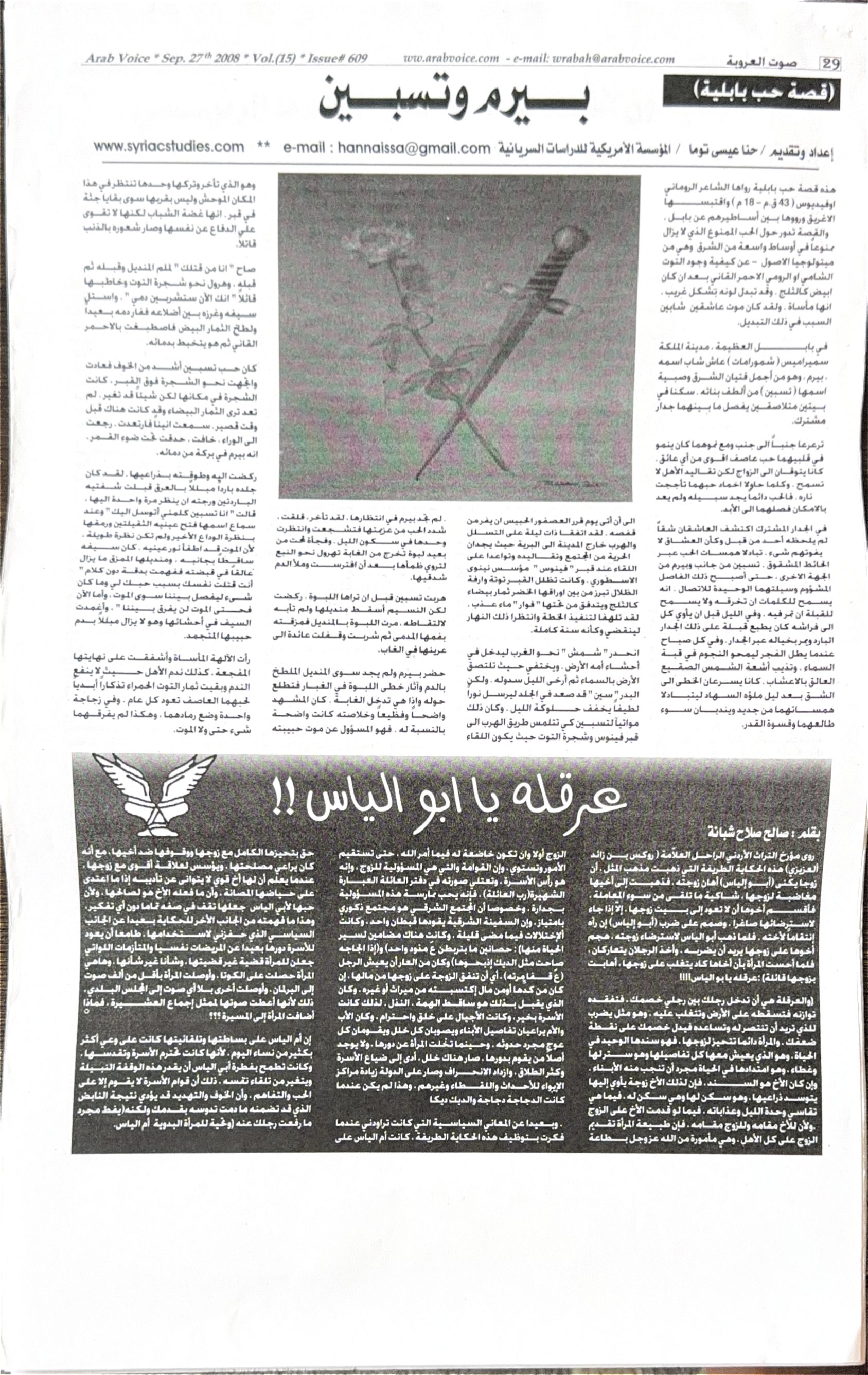
He cried out, "It is I who have killed you." He gathered up the veil and kissed it, and kissed it again, then hurried to the mulberry tree and addressed it, saying, "Now you shall drink my blood." He drew his sword and plunged it between his ribs, and his blood spurted far and stained the white fruits, so that they were dyed a deep blood-red; and then he writhed in his own blood.
Thisbe's love was stronger than her fear, so she returned and made her way toward the tree above the tomb. The tree was in its place, but something had changed. She no longer saw the white fruits that had been there a short while before. She heard a groan and shuddered. She drew back. She was afraid. She stared under the moonlight. It was Pyramus, in a pool of his own blood.
She ran to him and threw her arms around him. His skin was cold, damp with sweat. She kissed his cold lips and begged him to look at her just once. She said, "It is I, Thisbe. Speak to me, I implore you." At the sound of her name he opened his heavy eyes and gave her a last parting glance — a glance that was not long, for death had already extinguished the light of his eyes. His sword lay fallen beside him, and her torn veil was still clutched in his grip. And so she understood precisely, without a word: "You killed yourself because of your love for me, and nothing would have parted us but death. But now, not even death shall separate us." And she sheathed the sword in her own body while it was still wet with the frozen blood of her beloved.
The gods saw the tragedy and grieved over its heartbreaking end. So too did the families repent, when repentance was of no avail. And the red mulberry fruits remained an eternal memorial of their tempestuous love, returning every year. Their ashes were placed in a single vessel, and so nothing separated them — not even death.
Trip Him Up, Abu Ilyas!!
By: Saleh Salah Shabana
The late Jordanian heritage historian, the erudite Roks bin Za'id al-Uzayzi, recounted this amusing tale, which passed into currency as a proverb. A husband nicknamed Abu Ilyas insulted his wife. Angry with him, she went to her brother, complaining of the ill treatment she had received. Her brother swore that she would not return to her husband's house unless he came to appease her, humbled. And he resolved to strike Abu Ilyas the moment he saw him, in revenge for his sister. So when Abu Ilyas went to appease his wife, her brother pounced on his brother-in-law, meaning to strike him, and the two men fell to grappling. When the woman sensed that her brother was about to overcome her husband, she called out to her husband, saying: "Trip him up, Abu Ilyas!!!!"
(A "trip" is to slip your leg between your opponent's legs, so that he loses his balance and you throw him to the ground and overcome him. It is a proverb applied to the one you wish to see win, whom you set out to help, and who then reveals your weak point to your opponent. A woman always sides with her husband, for he is her sole support in life. He is the one who lives every detail of her life with her; he is her covering and her shield; he is her extension in life once she bears him children. And even if the brother is a support, that brother has a wife to whom he retires and on whose arms he rests his head — he is a dwelling for her and she a dwelling for him — while the sister endures the loneliness of the night and its torments, were she to place the brother above the husband. And because the brother has his standing and the husband his standing, it is a woman's nature to place the husband above all her kin. She is commanded by God Almighty to obey the husband first and to be submissive to him in what God has commanded, so that matters may be set straight and made even. Guardianship — that is, responsibility — belongs to the husband, and he is the head of the family. Above his likeness in the family register stands the famous phrase "head of the household," and he loves to exercise this responsibility with merit — especially since Eastern society is a patriarchal society par excellence, and the Eastern ship is steered by a single captain. In the past, disorders were few, and there were maxims for the conduct of life, among them: "Two stallions are not tied[?] at one manger," and "If the hen crows like the rooster, slaughter it." It was a disgrace for a man to live "off his wife's back" — that is, for the wife to support her husband from her own money, whether it came from her own labor or from money she had acquired through inheritance or otherwise. The man who accepted this was a man of fallen spirit, a wretch. For this reason the family was well, the generations were of good character and respect, and the father and mother would attend to the details of their children, correcting every flaw and straightening every crookedness the moment it occurred. And when the woman abandoned her role — and there is fundamentally no one to fill her role — a disorder arose that led to the ruin of the family and to much divorce. Deviance increased, and the state was obliged to increase shelters for juveniles, foundlings, and the like. This did not happen when the hen was a hen and the rooster a rooster.)
Setting aside the political meanings that occurred to me when I thought of putting this amusing tale to use: Umm Ilyas was right in siding completely with her husband and standing against her brother — even though he had her interest at heart and was laying the foundation for a stronger bond with her husband, when he learns that she has a strong brother who will not hesitate to discipline him should he transgress against her protected honor. What the brother did was for her benefit. Yet because her love for Abu Ilyas made her stand entirely by his side without a moment's thought — this is what I understood from the other side of the tale, apart from the political side that spurred me to use it — in the hope that the family may recover its role, far from the psychologically ill and the crisis-ridden women who have made for woman a cause not her own and an affair not her affair. And here the woman has obtained the quota, and a woman was brought into parliament with fewer than a thousand votes, and another was brought onto the municipal council with no votes at all, because she gave her vote to the representative of the tribe's consensus. So what has the woman added to the march?
Umm Ilyas, for all her simplicity and spontaneity, was far more aware than the women of today, because she respected the family and held it sacred. She aspired, by the instinct of Abu Ilyas, that he would appreciate this noble stand and change of his own accord — for the foundation of the family rests on nothing but love and understanding, and fear and threat may produce the result of a spring: you may hold it down as long as you press it with your foot, but it springs back the moment you lift your foot off it. And a salute to the Bedouin woman, Umm Ilyas.
اضغط على الصورة لفتحها بالحجم الكامل