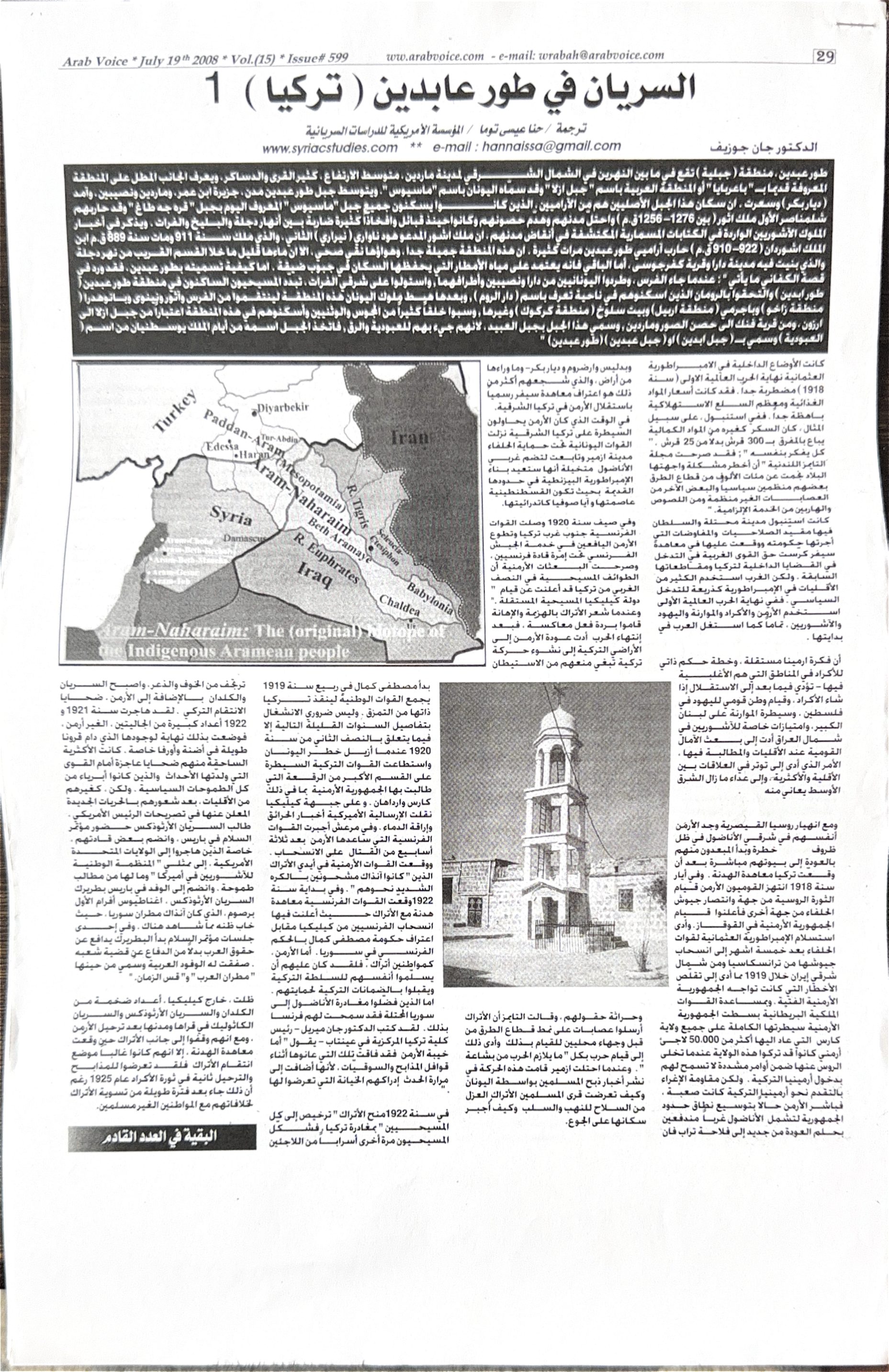
طور عبدين ، منطقة ( جبلية ) تقع في ما بين النهرين في الشمال الشرقي لمدينة ماردين ، متوسط الارتفاع ، كثير القرى والدساكر ، ويعرف الجانب المطل على المنطقة المعروفة قديما بـ " باعربايا " أو المنطقة العربية باسم " جبل ازلا " وقد سماه اليونان باسم " ماسيوس " . ويتوسط جبل طور عبدين مدن ، جزيرة ابن عمر ، وماردين ونصيبين ، وآمد ( ديار بكر ) وسعرت . ان سكان هذا الجبل الأصليين هم من الآراميين ، الذين كانوا يسكنون جميع جبل " ماسيوس " المعروف اليوم بجبل " قره جه طاغ " وقد حاربهم شلمناصر الأول ملك اثور ( بين 1276-1256 ق.م ) واحتل مدنهم وهدم حصونهم وكانوا حينئذ قبائل وافخاذا كثيرة ضارية بين أنهار دجلة والبليخ والفرات . ويذكر في أخبار الملوك الآشوريين الواردة في الكتابات المسمارية المكتشفة في أنقاض مدنهم ، ان ملك اشور المدعو هود ناواري ( نيراري ) الثاني ، والذي ملك سنة 911 ومات سنة 889 ق.م ابن الملك اشوردان ( 922-910 ق.م ) حارب آراميي طور عبدين مرات كثيرة . ان هذه المنطقة جميلة جدا . وهواؤها نقي صحي . الا ان ماءها قليل ما خلا القسم القريب من نهر دجلة والذي بنيت فيه مدينة دارا وقرية كفرجوسى ، أما الباقي فانه يعتمد على مياه الأمطار التي يحفظها السكان في جيوب ضيقة . اما كيفية تسميته بطور عبدين ، فقد ورد في قصة الكفاني⟨؟⟩ ما يأتي " : عندما جاء الفرس ، وطردوا اليونانيين من دارا ونصيبين وأطرافهما ، واستولوا على شرقي الفرات ، تبدد المسيحيون الساكنون في منطقة طور عبدين ( طور ابدين ) والتحقوا بالرومان الذين اسكنوهم في ناحية تعرف باسم ( دار الروم ) ، وبعدها هبط ملوك اليونان هذه المنطقة لينتقموا من الفرس وآثور ونينوى ويانوهدرا⟨؟⟩ ( منطقة زاخو ) وباجرمي ( منطقة اربيل ) وبيت سلوخ ( منطقة كركوك ) وغيرها ، وسبوا خلقا كثيرا من المجوس والوثنيين وأسكنوهم في هذه المنطقة اعتبارا من جبل ازلا الى ارزون ، ومن قرية فنك الى حصن الصور وماردين ، وسمي هذا الجبل بجبل العبيد ، لانهم جيء بهم للعبودية والرق ، فاتخذ الجبل اسمه من أيام الملك يوسطنيان من اسم ( العبودية ) وسمي بـ ( جبل ابدين ) او ( جبل عبدين ) ( طور عبدين ) "
كانت الأوضاع الداخلية في الامبراطورية العثمانية نهاية الحرب العالمية الاولى ( سنة 1918 ) مضطربة جدا . فقد كانت أسعار المواد الغذائية ومعظم السلع الاستهلاكية باهظة جدا . ففي استنبول ، على سبيل المثال ، كان السكر كغيره من المواد الكمالية يباع بالمفرق بـ 300 قرش بدلا من 25 قرش . " كل يفكر بنفسه " ; فقد صرحت مجلة التايمز اللندنية " أن أخطر مشكلة واجهتها البلاد نجمت عن مئات الألوف من قطاع الطرق بعضهم منظمين سياسيا والبعض الآخر من العصابات الغير منظمة ومن اللصوص والهاربين من الخدمة الإلزامية . "
كانت استنبول مدينة محتلة والسلطان فيها مقيد الصلاحيات والمفاوضات التي أجرتها حكومته ووقعت عليها في معاهدة سيفر كرست حق القوى الغربية في التدخل في القضايا الداخلية لتركيا ومقاطعاتها السابقة . ولكن الغرب استخدم الكثير من الأقليات في الإمبراطورية كذريعة للتدخل السياسي . ففي نهاية الحرب العالمية الأولى استخدم الأرمن والأكراد والموارنة واليهود والآشوريين ، تماما كما استغل العرب في بدايتها .
أن فكرة ارمينا مستقلة ، وخطة حكم ذاتي للأكراد في المناطق التي هم الأغلبية فيها - تؤدي فيما بعد إلى الاستقلال إذا شاء الأكراد ، وقيام وطن قومي لليهود في فلسطين ، وسيطرة الموارنة على لبنان الكبير ، وامتيازات خاصة للآشوريين في شمال العراق أدت إلى بعث الآمال القومية عند الأقليات والمطالبة فيها ، الأمر الذي أدى إلى توتر في العلاقات بين الأقلية والأكثرية ، وإلى عداء ما زال الشرق الأوسط يعاني منه
ومع انهيار روسيا القيصرية وجد الأرمن أنفسهم في شرقي الأناضول في ظل ظروف خطرة وبدأ المبعدون منهم بالعودة إلى بيوتهم مباشرة بعد أن وقعت تركيا معاهدة الهدنة . وفي أيار سنة 1918 انتهز القوميون الأرمن قيام الثورة الروسية من جهة وانتصار جيوش الحلفاء من جهة أخرى فأعلنوا قيام الجمهورية الأرمنية في القوقاز . وأدى استسلام الإمبراطورية العثمانية لقوات الحلفاء بعد خمسة اشهر إلى انسحاب جيوشها من ترانسكاسيا ومن شمال شرقي إيران خلال 1919 ما أدى إلى تقلص الأخطار التي كانت تواجه الجمهورية الأرمنية الفتية . وبمساعدة القوات الملكية البريطانية بسطت الجمهورية الأرمنية سيطرتها الكاملة على جميع ولاية كارس التي عاد اليها أكثر من 50.000 لاجئ أرمني كانوا قد تركوا هذه الولاية عندما تخلى الروس عنها ضمن أوامر مشددة لا تسمح لهم بدخول أرمينيا التركية . ولكن مقاومة الإغراء بالتقدم نحو أرمينيا التركية كانت صعبة ، فباشر الأرمن حالا بتوسيع نطاق حدود الجمهورية لتشمل الأناضول غربا مندفعين بحلم العودة من جديد إلى فلاحة تراب فان وبدليس وارضروم و ديار بكر - وما وراءها من أراض ، والذي شجعهم أكثر من ذلك هو اعتراف معاهدة سيفر رسميا باستقلال الأرمن في تركيا الشرقية .
في الوقت الذي كان الأرمن يحاولون السيطرة على تركيا الشرقية نزلت القوات اليونانية تحت حماية الحلفاء مدينة ازمير وتابعت لتضم غربي الأناضول متخيلة أنها ستعيد بناء الإمبراطورية البيزنطية في حدودها القديمة بحيث تكون القسطنطينية عاصمتها و آيا صوفيا كاتدرائيتها .
وفي صيف سنة 1920 وصلت القوات الفرنسية جنوب غرب تركيا وتطوع الأرمن اليافعين في خدمة الجيش الفرنسي تحت إمرة قادة فرنسيين ، وصرحت البعثات الأرمنية أن الطوائف المسيحية في النصف الغربي من تركيا قد أعلنت عن قيام " دولة كيليكيا المسيحية المستقلة . " وعندما شعر الأتراك بالهزيمة والإهانة قاموا بردة فعل معاكسة ، فبعد إنتهاء الحرب أدت عودة الأرمن إلى الأراضي التركية إلى نشوء حركة تركية تبغي منعهم من الاستيطان وحراثة حقولهم ، وقالت التايمز أن الأتراك أرسلوا عصابات على نمط قطاع الطرق من قبل وجهاء محليين للقيام بذلك وأدى ذلك إلى قيام حرب بكل " ما يلازم الحرب من بشاعة " . وعندما احتلت ازمير قامت هذه الحركة في نشر أخبار ذبح المسلمين بواسطة اليونان وكيف تعرضت قرى المسلمين الأتراك العزل من السلاح للنهب والسلب وكيف أجبر سكانها على الجوع .
بدأ مصطفى كمال في ربيع سنة 1919 يجمع القوات الوطنية لينقذ تركيا ذاتها من التمزق . وليس ضروري الانشغال بتفاصيل السنوات القليلة التالية إلا فيما يتعلق بالنصف الثاني من سنة 1920 عندما أزيل خطر اليونان واستطاعت القوات التركية السيطرة على القسم الأكبر من الرقعة التي طالبت بها الجمهورية الأرمنية بما في ذلك كارس وارداهان . و على جبهة كيليكيا نقلت الإرسالية الأميركية أخبار الحرائق وإراقة الدماء . وفي مرعش أجبرت القوات الفرنسية التي ساعدها الأرمن بعد ثلاثة أسابيع من القتال على الانسحاب . ووقعت القوات الأرمنية في أيدي الأتراك الذين " كانوا آنذاك مشحونين بالكره الشديد نحوهم " . وفي بداية سنة 1922 وقعت القوات الفرنسية معاهدة هدنة مع الأتراك حيث أعلنت فيها انسحاب الفرنسيين من كيليكيا مقابل اعتراف حكومة مصطفى كمال بالحكم الفرنسي في سوريا . أما الأرمن ، كمواطنين أتراك ، فلقد كان عليهم أن يسلموا أنفسهم للسلطة التركية ويقبلوا بالضمانات التركية لحمايتهم . اما الذين فضلوا مغادرة الأناضول إلى سوريا المحتلة فقد سمحت لهم فرنسا بذلك . لقد كتب الدكتور جان ميريل - رئيس كلية تركيا المركزية في عينتاب - يقول " أما خيبة الأرمن فقد فاقت تلك التي عانوها أثناء قوافل المذابح والسوقيات ، لأنها أضافت إلى مرارة الحدث إدراكهم الخيانة التي تعرضوا لها . "
في سنة 1922 منح الأتراك " ترخيص إلى كل المسيحيين " بمغادرة تركيا ، فشكل المسيحيون مرة أخرى أسرابا من اللاجئين ترجف من الخوف والذعر ، واصبح السريان والكلدان بالإضافة إلى الأرمن ، ضحايا الانتقام التركي . لقد هاجرت سنة 1921 و 1922 أعداد كبيرة من الجاليتين ، الغير أرمن ، فوضعت بذلك نهاية لوجودها الذي دام قرونا طويلة في أضنة وأورفا خاصة . كانت الأكثرية الساحقة منهم ضحايا عاجزة أمام القوى التي ولدتها الأحداث والذين كانوا أبرياء من كل الطموحات السياسية . ولكن ، كغيرهم من الأقليات ، بعد شعورهم بالحريات الجديدة المعلن عنها في تصريحات الرئيس الأمريكي ، طالب السريان الأرثوذكس حضور مؤتمر السلام في باريس ، وانضم بعض قادتهم ، خاصة الذين هاجروا إلى الولايات المتحدة الأمريكية ، إلى ممثلي " المنظمة الوطنية للآشوريين في أميركا " وما لها من مطالب طموحة . وانضم إلى الوفد في باريس بطريرك السريان الأرثوذكس ، اغناطيوس أفرام الأول برصوم ، الذي كان آنذاك مطران سوريا ، حيث خاب ظنه بما شاهد هناك . وفي إحدى جلسات مؤتمر السلام بدأ البطريرك يدافع عن حقوق العرب بدلا من الدفاع عن قضية شعبه . صفقت له الوفود العربية وسمي من حينها " مطران العرب " و " قس الزمان . "
ظلت ، خارج كيليكيا ، أعداد ضخمة من الكلدان والسريان الأرثوذكس والسريان الكاثوليك في قراها ومدنها بعد ترحيل الأرمن ، ومع انهم وقفوا إلى جانب الأتراك حين وقعت معاهدة الهدنة . إلا انهم كانوا غالبا موضع انتقام الأتراك فلقد تعرضوا للمذابح والترحيل ثانية في ثورة الأكراد عام 1925 رغم أن ذلك جاء بعد فترة طويلة من تسوية الأتراك لخلافاتهم مع المواطنين الغير مسلمين.
البقية في العدد القادم
Tur Abdin is a (mountainous) region located in Mesopotamia to the northeast of the city of Mardin. It is of moderate elevation and has many villages and hamlets. The side overlooking the region known in antiquity as "Beth Arabaye," or the Arab region, is known as "Mount Izla," and the Greeks called it "Masius." Mount Tur Abdin lies in the midst of the cities of Jazirat ibn Umar (Cizre), Mardin, Nisibis, Amid (Diyarbakir), and Siirt. The original inhabitants of this mountain were the Arameans, who used to dwell throughout the whole of Mount "Masius," known today as the "Karaca Dağ" mountain. Shalmaneser I, king of Assyria (between 1276 and 1256 BC), waged war against them, occupied their cities, and destroyed their fortresses; at that time they were tribes and clans, numerous and fierce, between the Tigris, the Balikh, and the Euphrates. It is recorded in the annals of the Assyrian kings found in the cuneiform inscriptions discovered among the ruins of their cities that the Assyrian king called Adad-nirari (Nirari) II [?], who reigned in 911 and died in 889 BC, son of King Ashur-dan (922–910 BC), waged war against the Arameans of Tur Abdin many times. This region is very beautiful, and its air is pure and healthful. Its water, however, is scarce, except for the part near the Tigris River, where the city of Dara and the village of Kafr Jusa were built; the rest depends on rainwater, which the inhabitants store in narrow cisterns. As for how it came to be called Tur Abdin, the story of al-Kafani [?] records the following: "When the Persians came and drove the Greeks out of Dara, Nisibis, and their environs, and seized the lands east of the Euphrates, the Christians dwelling in the region of Tur Abdin scattered and joined the Romans, who settled them in a district known as (Dar al-Rum). Afterward the Greek kings descended upon this region to take vengeance on the Persians and on Ashur, Nineveh, Banohadra [?] (the region of Zakho), Bajarmi (the region of Erbil), Beth Seloukh (the region of Kirkuk), and others, and they took captive a great multitude of Magians and pagans and settled them in this region, from Mount Izla to Arzun, and from the village of Finik to Hisn al-Sur and Mardin. This mountain was called the Mountain of the Slaves, because they had been brought for bondage and servitude, and so from the days of King Justinian the mountain took its name from (servitude) and was called (Mount Abdin) or (Mount Abdin) (Tur Abdin)."
The internal conditions in the Ottoman Empire at the end of the First World War (in 1918) were very turbulent. The prices of foodstuffs and most consumer goods were exorbitant. In Istanbul, for example, sugar, like other luxury items, was being sold at retail for 300 piastres instead of 25 piastres. "Every man for himself"; the London Times declared that "the gravest problem the country faced arose from the hundreds of thousands of brigands, some of them politically organized and others belonging to unorganized gangs, along with thieves and men fleeing compulsory service."
Istanbul was an occupied city, its sultan restricted in his powers, and the negotiations his government conducted and signed in the Treaty of Sèvres enshrined the right of the Western powers to interfere in the internal affairs of Turkey and its former provinces. But the West used many of the empire's minorities as a pretext for political interference. At the end of the First World War it used the Armenians, the Kurds, the Maronites, the Jews, and the Assyrians, just as it had exploited the Arabs at its beginning.
The idea of an independent Armenia; a plan for self-rule for the Kurds in the regions where they were the majority—leading later to independence should the Kurds wish it; the establishment of a national homeland for the Jews in Palestine; Maronite control over Greater Lebanon; and special privileges for the Assyrians in northern Iraq—all of these aroused nationalist hopes among the minorities and their demands, which led to tension in relations between minority and majority, and to a hostility from which the Middle East still suffers.
With the collapse of Tsarist Russia, the Armenians found themselves in eastern Anatolia under perilous circumstances, and those who had been deported began returning to their homes immediately after Turkey signed the armistice. In May 1918, the Armenian nationalists seized upon the outbreak of the Russian Revolution on the one hand and the victory of the Allied armies on the other, and declared the establishment of the Armenian Republic in the Caucasus. The surrender of the Ottoman Empire to the Allied forces five months later led to the withdrawal of its armies from Transcaucasia and from northeastern Iran during 1919, which reduced the dangers facing the young Armenian Republic. With the help of the British royal forces, the Armenian Republic extended its full control over the entire province of Kars, to which more than 50,000 Armenian refugees returned—refugees who had left this province when the Russians abandoned it, under strict orders not to permit them to enter Turkish Armenia. But resisting the temptation to advance toward Turkish Armenia was difficult, so the Armenians at once set about expanding the borders of the Republic to include Anatolia to the west, driven by the dream of returning once more to till the soil of Van, Bitlis, Erzurum, and Diyarbakir—and the lands beyond them. What encouraged them still further was the Treaty of Sèvres's official recognition of Armenian independence in eastern Turkey.
At the very time the Armenians were trying to take control of eastern Turkey, Greek forces landed under Allied protection at the city of Izmir and pressed on to annex western Anatolia, imagining that they would rebuild the Byzantine Empire within its ancient borders, with Constantinople as its capital and Hagia Sophia as its cathedral.
In the summer of 1920, French forces arrived in southwestern Turkey, and young Armenians volunteered to serve in the French army under the command of French officers. The Armenian missions declared that the Christian communities in the western half of Turkey had proclaimed the establishment of the "Independent Christian State of Cilicia." When the Turks felt defeated and humiliated, they reacted in the opposite direction: after the war ended, the return of the Armenians to Turkish lands gave rise to a Turkish movement seeking to prevent them from settling and tilling their fields. The Times reported that the Turks had sent gangs of the same brigand type as before, dispatched by local notables to carry this out, and this led to a war with all "the ugliness that accompanies war." When Izmir was occupied, this movement set about spreading reports of the slaughter of Muslims by the Greeks, and how the villages of the unarmed Turkish Muslims were subjected to pillage and plunder, and how their inhabitants were driven to starvation.
In the spring of 1919, Mustafa Kemal began gathering the national forces to save Turkey itself from being torn apart. There is no need to dwell on the details of the few following years except as regards the second half of 1920, when the Greek threat was removed and the Turkish forces were able to gain control of the greater part of the territory claimed by the Armenian Republic, including Kars and Ardahan. On the Cilician front, the American mission relayed reports of fires and bloodshed. At Marash, the French forces, aided by the Armenians, were forced to withdraw after three weeks of fighting. The Armenian forces fell into the hands of the Turks, who "were at that time charged with intense hatred toward them." At the beginning of 1922, the French forces signed an armistice with the Turks, in which they announced the withdrawal of the French from Cilicia in return for Mustafa Kemal's government recognizing French rule in Syria. As for the Armenians, being Turkish citizens, they had to surrender themselves to the Turkish authority and accept the Turkish guarantees for their protection. Those who preferred to leave Anatolia for occupied Syria were permitted by France to do so. Dr. John Merrill—president of Central Turkey College in Aintab—wrote, saying: "The Armenians' disillusionment exceeded that which they had suffered during the caravans of massacres and deportations, for it added to the bitterness of the event their awareness of the betrayal they had been subjected to."
In 1922, the Turks granted "permission to all Christians" to leave Turkey, and so the Christians once again formed flocks of refugees trembling with fear and terror, and the Syriacs and Chaldeans, in addition to the Armenians, became victims of Turkish vengeance. In 1921 and 1922, large numbers of the two non-Armenian communities emigrated, thus putting an end to their existence, which had lasted for many long centuries, especially in Adana and Urfa. The overwhelming majority of them were helpless victims before the forces that events had generated, and were innocent of all political ambitions. Yet, like the other minorities, after they felt the new freedoms proclaimed in the declarations of the American president, the Syriac Orthodox demanded to attend the Peace Conference in Paris, and some of their leaders—especially those who had emigrated to the United States of America—joined the representatives of the "Assyrian National Organization in America" and its ambitious demands. Joining the delegation in Paris was the Syriac Orthodox patriarch, Ignatius Aphrem I Barsoum, who was at that time metropolitan of Syria, and who was disappointed by what he saw there. In one of the sessions of the Peace Conference, the patriarch began defending the rights of the Arabs instead of defending the cause of his own people. The Arab delegations applauded him, and from then on he was called "the Metropolitan of the Arabs" and "the Priest of the Age."
Outside Cilicia, vast numbers of Chaldeans, Syriac Orthodox, and Syriac Catholics remained in their villages and towns after the deportation of the Armenians, and although they had sided with the Turks when the armistice was signed, they were nonetheless often the object of Turkish vengeance: they were subjected to massacres and deportation again in the Kurdish revolt of 1925, even though this came long after the Turks had settled their disputes with the non-Muslim citizens.
To be continued in the next issue
اضغط على الصورة لفتحها بالحجم الكامل