من المتعارف عليه أنّ المؤرخين يولون اهتماماً خاصاً وكبيرا بالتحديات المصيرية التي تواجهه الشعوب . أو المآسي التي تختبرها بعض الأمم وتعاني من ويلاتها . وغالبا ما يشتهر مؤرخ ما لأنه أرخ لمرحلة حاسمة كانت تعتبر منعطفا تاريخيا في حياة المجتمع الإنساني . فكلما دار الحديث عن الإمبراطورية الرومانية مثلا ، جاء ذكر " إدوار غيبون " وكتابه " سقوط الإمبراطورية الرومانية " . لأن كتاب غيبون يمد⟨؟⟩ القارئ بفيض من المعلومات الموثقة والمدعومة بالحجة المنطقية والتحليل الموضوعي للعوامل التي ساهمت في التحولات الجذرية التي مر بها المجتمع الروماني والتي أدت بالتالي إلى انحلاله وتدهوره . ما جعل هذا الكتاب يحتل مكانة رفيعة لدى جميع المعنيين بالتاريخ الروماني . ولكن ، إذا كانت روما قد حظيت بمؤرخ مثل غيبون يؤرخ لأزماتها بدقة علمية فإن الشرق الأوسط ، وإن كان قد واجه ( ولا يزال ) أزمات لا تقل حدة عن تلك التي واجهتها روما ، لم يتح للمؤرخين فيه حرية التفكير والبحث الموضوعيين ، حتى يتسنى لهم تطبيق المنهجيات العلمية على القضايا التاريخية دون الرضوخ لفرضيات مسبقة أملتها السلطة أو روجت لها بعض الأوساط الثقافية أو الدينية . ومع اعتبار أن يكون رائد العمل إنصاف الحقائق التاريخية ، وليس إرضاء هذه السلطة أو تلك.
منذ مذبحة العام 1915 ظهرت كتب عديدة تناولت نشوء الإمبراطورية العثمانية وتطورها وانحلالها ، كتب معظمها مختصون غربيون وشرقيون اهتموا بالأزمات السياسية والاقتصادية والقومية والاجتماعية وحتى الثقافية لدى العثمانيين . غير أننا لم نعثر حتى الآن على كتاب واحد يتناول أبديولوجية الأتراك القومية التي تطورت مع بداية القرن العشرين ، والتي نشأت منها عنصرية عرقية دينية حرضت العثمانيين الأتراك على تغيير نظرتهم إلى الأقليات وتعديل موقفهم منها وبالتالي الإقدام على تصفيات جماعية لهذه الأقليات. ليس هناك من أرخ للمذابح التي أودت بحياة أكثر من مليوني أرمني ونصف مليون سرياني ما خلا بعض الكتاب الأرمن . وليس هناك أيضا من يحدد بدقة علمية السياق العام للأحداث العالمية والشرق أوسطية التي سبقت المذابح أو عاصرتها ومدى الدور الذي قامت به تلك الأحداث في التحريض على تصفية السريان الذين اشتهروا منذ فجر المسيحية باهتمامهم بالقضايا الثقافية والعلمية . تلك القضايا التي من أجل نشرها وتطويرها بنوا جامعات ( جنديسابور ، والرها ، ونصيبين ، ورأس العين ، ولافات⟨؟⟩ ) التي درست ونشرت علوما يونانية وسريانية ساهمت كثيرا في تطور الشعوب البيزنطية والفارسية والعربية والعثمانية وتقدمها .
صحيح أنّ المسيحية قاسم مشترك بين السريان والأرمن ، إلاّ أنّه لم يكن للسريان ثمّة همّ سياسي ، ولم يطالبوا بإقامة وطن لهم . بل اكتفوا بأن يكونوا مواطنون يتقيدون بقوانين المجتمعات التي تواجدوا فيها . وعبر تاريخهم الطويل كان السريان قد انفتحوا على جميع شعوب تلك المجتمعات سواء كانت وثنية أو مسيحية أو مسلمة وتفاعلوا معها وعملوا على تقدمها . لذلك ، يبقى أمر المذابح التي تعرض لها السريان لغزا يستحق البحث الجدي .
سواء أكانت للمذابح الجماعية التي تعرّض لها الأرمن والسريان علاقة بالشؤون السياسية أو القومية لهذا البلد أو ذاك أم لا إلاّ أنها لا يجوز أن يتجاهلها المؤرخون والباحثون لأنها تبقى ، في جوهرها مسألة تهم البشرية جمعاء بما في ذلك هؤلاء الذين ارتكبوها . لأنّ الذين أقدموا على القتل والتدمير هم من حيث الجوهر بشر كالذين تمت إبادتهم ولم يتحولوا إلى قتلة إلا في ظل نظام سياسي واجتماعي أضفت أبديولوجيته الصفات المثالية المطلقة على مثل المواطن العثماني وقيمه وأفكاره وجردت الآخرين ( الأقليات الأرمنية والسريانية ) من قيمهم ومثلهم البشرية تمهيدا للقضاء عليهم . فأبديولوجية العثمانيين الأتراك القومية كانت قد كونت بيئة ثقافية ونفسية جعلت الفرد العثماني ينشأ على مطلقية شخصيته⟨؟⟩ القومية وصفاءها وسموها وتميزها وتفوقها. وكانت هذه الأبديولوجية قد هيمنت على مؤسسات المجتمع السياسية والاجتماعية والتربوية والثقافية والدينية لدرجة أن الإنسان العثماني لم يكن إلا صدى لها . بمعنى آخر ، إن الأيديولوجية كانت قد استبدت بالإنسان العثماني وصارت هي التي تفكر وتفعل وتشرع بحيث صار الفرد العثماني أداة في يد الأبديولوجية الحاكمة .
لذلك ، ينبغي أن تُدرس المذابح التي أقدم عليها العثمانيون من منظور تاريخي وأبديولوجي ولا علاقة لذلك كله بجوهر الفرد العثماني . فهو من حيث الجوهر لا يختلف عن الأرمني أو السرياني . الاختلاف هو في الإطار الأيديولوجي الذي يحدد رؤية الإنسان لنفسه وللآخر ، لأنه عندما يقدم الإنسان على فعل إيجابي أو سلبي فهو ينطلق من قواعد فكرية ( أيديولوجية ) هي بمنزلة قناعات مطلقة لديه . لا يراوده الشك في مصداقيتها وشرعيتها ، لدرجة أنه ليس قادرا على أن يفكر أو أن يفعل إلا من خلال تعليلها وتبريرها وتشريعها . فالإبادة فعل استوجبته وبررته مسبقا أيديولوجية عنصرية قبل أن تنفذه أيد بشرية . لذا ، نرى ضرورة القيام بنقد علمي شامل لمثل هذه الأيديولوجيات التي تحرم الإنسان التفكير العلمي والانفتاح على الآخرين ، والقبول بهم وإن اختلفوا عنه في سياستهم ودينهم وقوميتهم وثقافتهم .
عندما نؤكد على تحديد إطار مذبحة العام 1915 التاريخي فإننا ننطلق من مبدأ أن المذبحة هي ظاهرة تاريخية محضة . وعندما ندرسها كظاهرة تاريخية نستطيع بذلك تحديد المسؤولية دون السقوط في متاهات التجريد والتعميم التي مارسها بعض الكتاب الذين تعرضوا للمذبحة . مثلاً . بعض الكتب العربية التي أرخت لمذابح السريان التي وقعت في العام 1915 اكتفت ، عامة ، بوصف المذابح وطريقة تنفيذها في معزل عن السياق التاريخي العام . فالأحداث على الرغم من مأساتها وبشاعتها تكاد تكون سلسلة من الحوادث الاعتياطية المجانية التي قلما تجد لها تبريرا منطقيا أو عقليا . لأن مؤرخي تلك الأحداث اكتفوا بتصوير الحدث بذاته دون أن يعلّلوا خلفياته ودوافعه أو يحددوا العوامل المحرّضة على وقوعه والتي هي عوامل تاريخية بحتة . لذلك ، التبس عليهم - وعلى قرائهم - فهم الغاية أو الغرض السياسي والقومي والاستراتيجي من وراء تلك المذابح .
إن أيّ حدث تاريخي لا بدّ أن يصدر عن جماعة معيّنة لها ظروفها التاريخية, وانخراط أي جماعة في أي فعل أو حدث تاريخي لا بد أن يكون مشروطا بجملة من العوامل وله بعض المبررات ، وبالتالي ، لا بد من أن يهدف القيمون على الحدث إلى تحقيق غاية ما . هكذا ينبغي أن ننظر إلى التاريخ لكي يتسنى لنا فهم آلياته وأغراضه . عندما يدرس الحدث التاريخي من منظور علمي عندها يستطيع القارئ والدارس أن يفهما الحدث على أنه ظاهرة تاريخية ، أي ظاهرة تنشأ في مكان وزمان ، وتخضع لشروط معينة ، وتمثل جماعة لها سياسة معينة ، وترمي إلى تحقيق غرض معين ضمن مرحلة تاريخية معينة . فالحدث التاريخي لكي يفهم. لا بد أن ننظر إليه على أنه جزء من كل ، وحين نفهم طبيعة المرحلة التاريخية واتجاهاتها العامة . عندها نستطيع أن نفهم علميا ما حصل في التاريخ.
رغم أنّ التاريخ هو منهج ينصبّ على دراسة الماضي إلاّ أنه دائما يتوجه إلى الإنسان في الحاضر . يستجلي المؤرخ الغموض والالتباس والاختلاط الذي قد أحاط بالأحداث التاريخية حتى يوفر لنا . في الحاضر ، صورة جلية واضحة متحررة من الأوهام التي علقت بأذهان الناس . بمعنى آخر ، إن مهمة المؤرخ الرئيسية لا تنحصر في أن يضعنا في اتصال علمي مع الماضي لكي نفهم كيفية تكوينه ومقوماته واتجاهاته وحسب ، بل تمتد إلى تبيان مدى استمرار مؤثرات ذلك الماضي في حاضرنا وأثره في حياتنا الآن . حين تتوافر لدينا نظرة إلى التاريخ علمية نقدية نكون بذلك قد اطلعنا على الماضي بتجرد وموضوعية, وتوافرت لنا الجرأة في نقد الماضي ، والتحرر من عقدة النقص والتبجح ، وانفتحنا على نحو خلاق على إمكانات الحاضر والمستقبل .
بعض نتائج هذه النظرة العلمية للتاريخ تمّ تطبيقه ، إلى حد ما، على مذابح العام 1915 التي أودت بحياة أكثر من مليون أرمني وزهاع ربع مليون سرياني. قد يجد القارئ فيضا من المعلومات عن القضية الأرمنية كتبتها أقلام غربية أو باحثون أرمن. المؤسف في الأمر أنه، حتى الآن، لا يوجد كتاب موضوعي واحد يتناول المذابح التي تعرض لها السريان . وحين يتناول الباحثون الأرمن موضوع مذابح عام 1915 . لا يأتي أحد على ذكر المجازر التي تعرض لها السريان رغم تزامن المذبحتين وتلاحمها⟨؟⟩. وكأن المذابح صارت حكرا لجماعة معينة دون أخرى . إن هذه الدراسة ، على أهميتها تبقى محاولة متواضعة همها تعريف القارئ بالخلفيات السياسية والقومية والثقافية التي تبلورت في بداية القرن العشرين ومهدت تدريجيا للمذبحة . أما غاية هذه الدراسة الرئيسية فهي تعميق الوعي العلمي للتاريخ الذي رافق مذبحة العام 1915 وتأصيله.
الابادة الجماعية
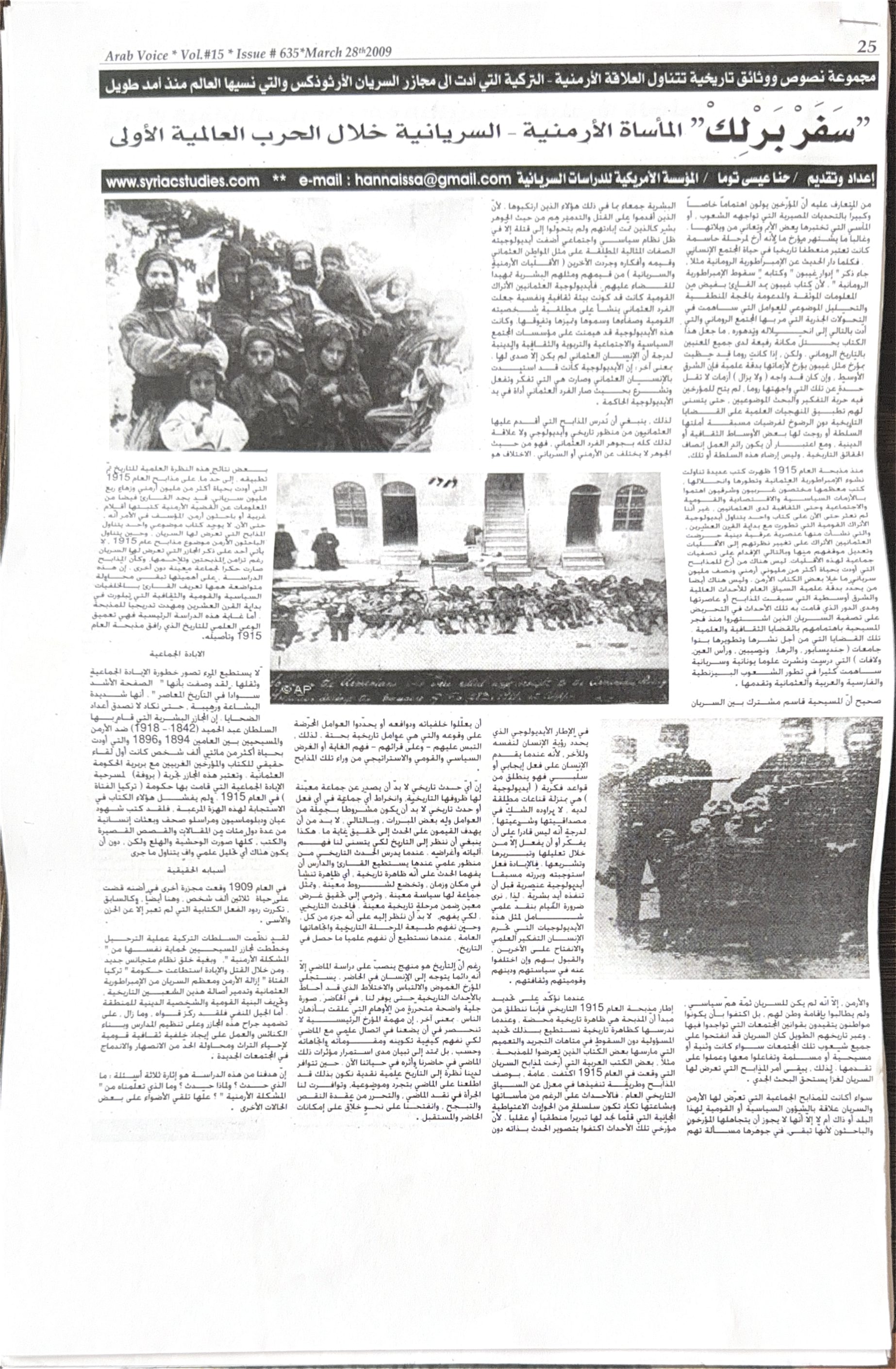
لا يستطيع المرء تصور خطورة الإبادة الجماعية وثقلها . لقد وصفت بأنها " الصفحة الأشد سوادا في التاريخ المعاصر " . أنها شديدة البشاعة ورهيبة ، حتى نكاد لا نصدق أعداد الضحايا . إن المجازر البشرية التي قام بها السلطان عبد الحميد (1842 - 1918) ضد الأرمن والمسيحيين بين العامين 1894 و1896 والتي أودت بحياة أكثر من مائتي ألف شخص كانت أول لقاء حقيقي للكتاب والمؤرخين الغربيين مع بربرية الحكومة العثمانية . وتعتبر هذه المجازر تجربة ( بروفة ) لمسرحية الإبادة الجماعية التي قامت بها حكومة ( تركيا الفتاة ) في العام 1915 . ولم يفشل هؤلاء الكتاب في الاستجابة لهذه الهزة المرعبة ، فلقد كتب شهود عيان ودبلوماسيون ومراسلو صحف وبعثات إنسانية من عدة دول مئات من المقالات والقصص القصيرة والكتب ، كلها صورت الوحشية والهلع ولكن ، دون أن يكون هناك أي تحليل علمي واف يتناول ما جرى
أسبابه الحقيقية
في العام 1909 وقعت مجزرة أخرى في أضنه قضت على حياة ثلاثين ألف شخص . وهنا أيضا . وكالسابق ، تكررت ردود الفعل الكتابية التي لم تعبر إلا عن الحزن والأسى .
لقد نظّمت السلطات التركية عملية الترحيل وخططت لمجازر المسيحيين لحماية نفسها من " المشكلة الأرمنية " . وبغية خلق نظام متجانس جديد . ومن خلال القتل والإبادة استطاعت حكومة " تركيا الفتاة " إزالة الأرمن ومعظم السريان من الإمبراطورية العثمانية وتدمير أصالة هذين الشعبين التاريخية . وتحريف البنية القومية والشخصية الدينية للمنطقة . أما الجيل المنفي فلقد ركز قواه ، وما زال ، على تضميد جراح هذه المجازر وعلى تنظيم المدارس وبناء الكنائس والعمل على إيجاد خلفية ثقافية قومية لإحياء التراث ومحاولة الحد من الانصهار والاندماج في المجتمعات الجديدة .
إنّ هدفنا من هذه الدراسة هو إثارة ثلاثة أسئلة : ما الذي حدث ؟ ولماذا حدث ؟ وما الذي تعلمناه من " المشكلة الأرمنية " ؟ علها تلقي الأضواء على بعض الحالات الأخرى .
It is generally acknowledged that historians devote special and considerable attention to the fateful challenges that confront peoples, or the tragedies that certain nations experience and whose calamities they endure. A given historian often becomes renowned because he chronicled a decisive era considered a historical turning point in the life of human society. Whenever the Roman Empire is discussed, for instance, "Edward Gibbon" and his book "The Decline and Fall of the Roman Empire" are mentioned, because Gibbon's book furnishes[?] the reader with an abundance of documented information supported by logical argument and objective analysis of the factors that contributed to the radical transformations the Roman society underwent, which in turn led to its dissolution and decline. This is what made his book occupy an elevated place among all those concerned with Roman history. Yet if Rome was fortunate enough to have a historian like Gibbon to chronicle its crises with scientific precision, the Middle East, though it has faced (and still faces) crises no less severe than those Rome faced, has not granted its historians the freedom of objective thought and inquiry that would enable them to apply scientific methodologies to historical questions without submitting to preconceived hypotheses dictated by the authorities or promoted by certain cultural or religious circles, on the understanding that the pioneering aim of the work should be to do justice to historical truths, rather than to please this authority or that.
Since the massacre of 1915, numerous books have appeared dealing with the rise, development, and dissolution of the Ottoman Empire, most of them written by Western and Eastern specialists concerned with the political, economic, national, social, and even cultural crises of the Ottomans. Yet we have not until now found a single book that addresses the Turkish national ideology that developed with the beginning of the twentieth century, from which arose an ethnic-religious racism that incited the Ottoman Turks to change their view of the minorities and to alter their stance toward them, and consequently to embark upon the mass liquidation of these minorities. There is no one who has chronicled the massacres that took the lives of more than two million Armenians and half a million Syriacs, apart from a few Armenian writers. Nor is there anyone who defines with scientific precision the general context of the world and Middle Eastern events that preceded or coincided with the massacres, and the extent of the role those events played in inciting the liquidation of the Syriacs, who had been renowned since the dawn of Christianity for their concern with cultural and scientific matters. It was for the sake of disseminating and developing these matters that they built universities (Gundeshapur, Edessa, Nisibis, Ras al-Ayn, and Lafat[?]) that taught and disseminated Greek and Syriac sciences that contributed greatly to the development and advancement of the Byzantine, Persian, Arab, and Ottoman peoples.
It is true that Christianity is a common denominator between the Syriacs and the Armenians, yet the Syriacs had no political ambition, and they did not demand the establishment of a homeland for themselves. Rather, they were content to be citizens who abided by the laws of the societies in which they lived. Throughout their long history the Syriacs had opened themselves to all the peoples of those societies, whether pagan, Christian, or Muslim, interacted with them, and worked toward their advancement. For this reason, the matter of the massacres the Syriacs were subjected to remains a riddle deserving of serious inquiry.
Whether or not the mass massacres to which the Armenians and Syriacs were subjected were related to the political or national affairs of this country or that, historians and researchers may not disregard them, because they remain, in their essence, a matter that concerns all of humanity, including those who committed them. For those who undertook the killing and destruction are, in essence, human beings like those who were exterminated, and they did not turn into killers except under a political and social system whose ideology conferred absolute ideal attributes upon the model Ottoman citizen and his values and ideas, while stripping the others (the Armenian and Syriac minorities) of their human values and ideals in preparation for their annihilation. The national ideology of the Ottoman Turks had formed a cultural and psychological environment that made the Ottoman individual grow up on the absoluteness of his national personality[?] and its purity, loftiness, distinctiveness, and superiority. This ideology had dominated the political, social, educational, cultural, and religious institutions of the society to the point that the Ottoman person was nothing but an echo of it. In other words, the ideology had taken tyrannical hold of the Ottoman person and became the one that thought and acted and legislated, so that the Ottoman individual became an instrument in the hands of the ruling ideology.
Therefore, the massacres the Ottomans undertook ought to be studied from a historical and ideological perspective, and all of this has nothing to do with the essence of the Ottoman individual. For he is, in essence, no different from the Armenian or the Syriac. The difference lies in the ideological framework that determines a person's vision of himself and of the other, because when a person undertakes a positive or negative act, he sets out from intellectual (ideological) premises that stand in the place of absolute convictions for him, convictions whose credibility and legitimacy he never doubts, to the point that he is unable to think or to act except through their justification, rationalization, and legitimization. Extermination is an act that a racist ideology necessitated and justified in advance, before human hands carried it out. Hence we see the necessity of undertaking a comprehensive scientific critique of such ideologies, which deprive a person of scientific thinking and of openness to others, and of accepting them even if they differ from him in their politics, religion, nationality, and culture.
When we insist on defining the historical framework of the massacre of 1915, we set out from the principle that the massacre is a purely historical phenomenon. And when we study it as a historical phenomenon, we are thereby able to determine responsibility without falling into the labyrinths of abstraction and generalization practiced by some of the writers who addressed the massacre. For example, some of the Arabic books that chronicled the massacres of the Syriacs that occurred in 1915 contented themselves, in general, with describing the massacres and the manner of their execution in isolation from the general historical context. So the events, despite their tragedy and hideousness, appear almost as a series of arbitrary, gratuitous incidents that seldom find any logical or rational justification, because the chroniclers of those events contented themselves with depicting the event in itself without explaining its backgrounds and motives or identifying the factors that incited its occurrence, which are purely historical factors. For this reason, the aim, or the political, national, and strategic purpose, behind those massacres was obscured for them, and for their readers.
Any historical event must issue from a particular group with its own historical circumstances, and the involvement of any group in any historical act or event must be conditioned by a set of factors and must have certain justifications, and consequently, those in charge of the event must aim to achieve some goal. This is how we ought to look at history so that we may understand its mechanisms and its purposes. When the historical event is studied from a scientific perspective, the reader and the student can then understand the event as a historical phenomenon, that is, a phenomenon that arises in a place and a time, is subject to certain conditions, represents a group with a certain policy, and aims to achieve a certain purpose within a certain historical stage. For the historical event to be understood, we must look at it as a part of a whole, and when we understand the nature of the historical stage and its general tendencies, we are then able to understand scientifically what happened in history.
Although history is a discipline focused on the study of the past, it is always directed toward the human being in the present. The historian illuminates the obscurity, ambiguity, and confusion that may have surrounded historical events so as to provide us, in the present, with a clear and lucid picture free of the illusions that have clung to people's minds. In other words, the historian's principal task is not confined to placing us in scientific contact with the past so that we may understand how it was formed and its constituents and tendencies alone, but extends to demonstrating the extent to which the influences of that past continue in our present and their effect on our lives now. When we possess a scientific, critical view of history, we have thereby examined the past with detachment and objectivity, and we have acquired the boldness to criticize the past, to free ourselves from the complex of inferiority and boastfulness, and to open ourselves creatively to the possibilities of the present and the future.
Some of the results of this scientific view of history have been applied, to a certain extent, to the massacres of 1915 that took the lives of more than a million Armenians and roughly a quarter of a million Syriacs. The reader may find an abundance of information about the Armenian question written by Western pens or by Armenian researchers. What is regrettable in the matter is that, until now, there is not a single objective book that addresses the massacres to which the Syriacs were subjected. And when Armenian researchers address the subject of the massacres of 1915, no one mentions the massacres to which the Syriacs were subjected, despite the two massacres' coincidence and interlocking[?]. It is as though the massacres had become the exclusive preserve of one particular group and not another. This study, for all its importance, remains a modest attempt whose concern is to acquaint the reader with the political, national, and cultural backgrounds that took shape at the beginning of the twentieth century and gradually paved the way for the massacre. As for the principal aim of this study, it is to deepen the scientific awareness of the history that accompanied the massacre of 1915 and to root it firmly.
Genocide
One cannot conceive of the gravity of genocide and its weight. It has been described as "the darkest page in contemporary history." It is so hideous and terrible that we can scarcely believe the numbers of the victims. The human massacres carried out by Sultan Abdul Hamid (1842–1918) against the Armenians and the Christians between the years 1894 and 1896, which took the lives of more than two hundred thousand people, were the first true encounter of Western writers and historians with the barbarity of the Ottoman government. These massacres are regarded as a trial (rehearsal) for the play of genocide carried out by the government of (the Young Turks) in 1915. These writers did not fail to respond to this terrifying shock; eyewitnesses, diplomats, newspaper correspondents, and humanitarian missions from several countries wrote hundreds of articles, short stories, and books, all of which depicted the brutality and the horror, but without there being any adequate scientific analysis addressing what took place.
Its True Causes
In 1909 another massacre occurred in Adana that claimed the lives of thirty thousand people. Here too, as before, the written reactions were repeated, expressing nothing but sorrow and grief.
The Turkish authorities organized the deportation operation and planned the massacres of the Christians in order to protect themselves from the "Armenian problem," and with a view to creating a new homogeneous order. Through killing and extermination, the government of the "Young Turks" was able to remove the Armenians and most of the Syriacs from the Ottoman Empire, to destroy the historical authenticity of these two peoples, and to distort the national structure and religious character of the region. As for the exiled generation, it concentrated its energies, and still does, on binding up the wounds of these massacres, on organizing schools, building churches, and working to create a national cultural foundation to revive the heritage and to attempt to limit assimilation and integration into the new societies.
Our aim in this study is to raise three questions: What happened? Why did it happen? And what have we learned from the "Armenian problem"? Perhaps it may shed light on some other cases.
اضغط على الصورة لفتحها بالحجم الكامل