تمهيد : لعلَّ من الضروري القول : أنَّ الحضارة ، أيَّة حضارة ، ليست ثمرةَ جهود فرد ، أو شعب ، أو مجموعةً أُم⟨؟⟩ ، بل هي صنعُ الإنسان في مختلفِ عصورِه القديمة والحديثة والمستقبليَّة ، يتضافرُ ويتكافلُ لخَلقِها مع أخيه الإنسان للسير والانتقال من حَسَنٍ إلى أحسن . وقد تولي أُمَّةٌ ما اهتمامَها لناحيةٍ حضاريَّةٍ من دون الأخرى ، وتُسهِم من ثَمَّ على قدرِ طاقتِها في تشييدِ صَرحِ هذه الحضارة الإنسانيَّة العالميَّة التي ينعم بها الجميعُ على تفاوتٍ تَبَعاً للمؤهلات والظروف.
فلا فضلَ والحالةُ هذه لشَعبٍ على آخر ، إذ لا حياةً ولا استمراراً للجهد الإنساني الكبير إذا لم يعضِّده الأفراد في أي قُطرٍ وُجدوا ، وفي أي وقتٍ عاشوا . وهكذا تظهر بوضوحٍ كُلِّيٍّ تلك الصفة الاجتماعيَّة ــ الاشتراكيَّة التي تربطُ الإنسانَ بأخيه الإنسان مهما اختلف اللون ، وتميَّز العِرق ، وبَعُدت المسافات ، إذ أنَّ الحضارة الإنسانيَّة للإنسانِ ، ونتيجةُ جهد الإنسان وفي خدمةِ الإنسان.
الرها مهد الأدب الآرامي
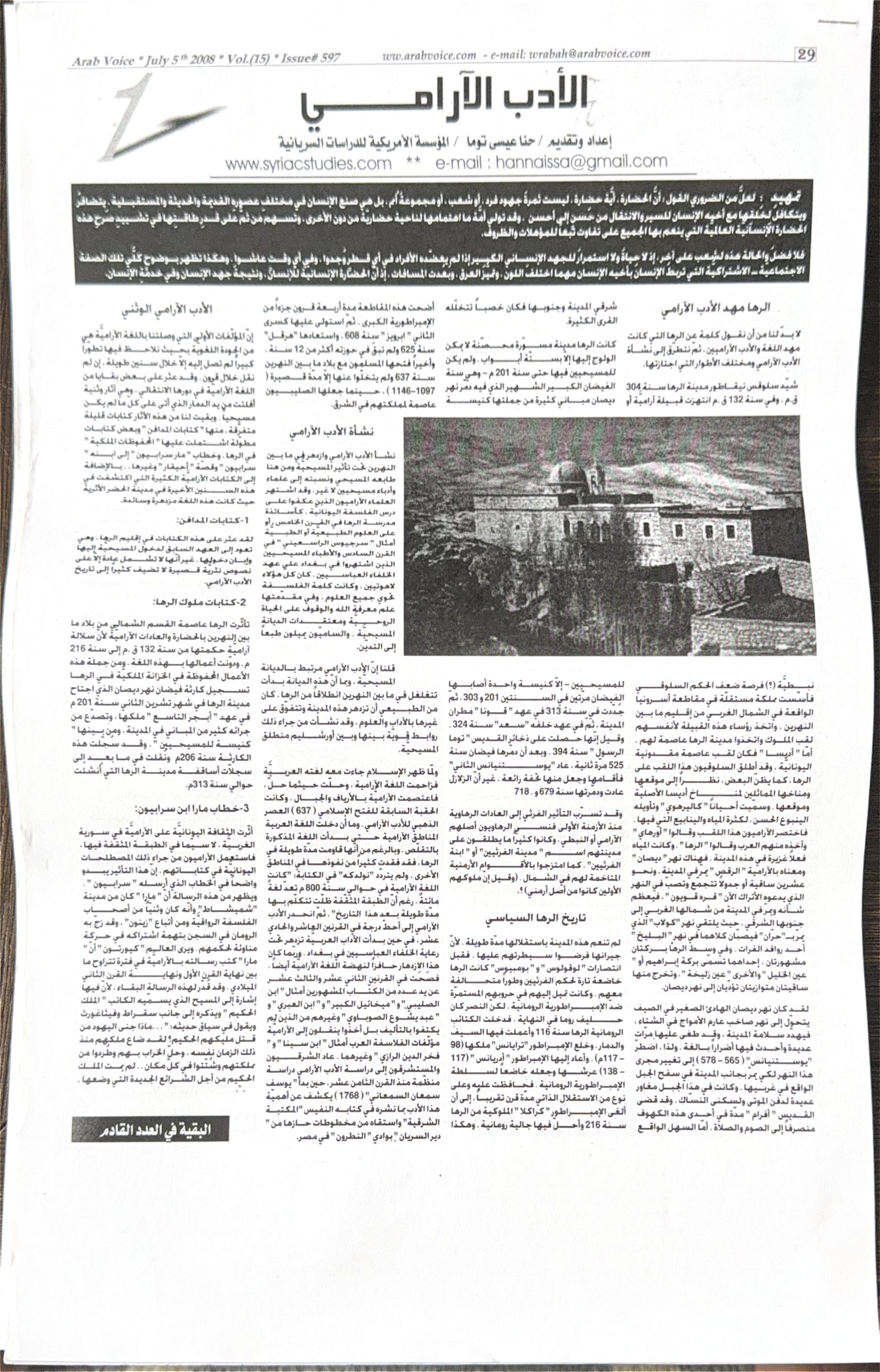
لا بدَّ لنا من أن نقول كلمة عن الرها التي كانت مهد اللغة والأدب الآراميين ، ثم نتطرق إلى نشأة الأدب الآرامي ومختلف الأطوار التي اجتازتها.
شيَّد سلوقس نيقاطور مدينة الرها سنة 304 ق.م . وفي سنة 132 ق.م انتهزت قبيلة آراميَّة أو نبيطيَّة (؟) فرصة ضعف الحكم السلوقي فأسّست مملكة⟨؟⟩ مستقلّة في مقاطعة أسرونيا الواقعة في الشمال الغربي من إقليم ما بين النهرين ، واتخذ رؤساء هذه القبيلة لأنفسهم لقب الملوك واتخذوا مدينة الرها عاصمة لهم . أمّا " أديسا " فكان لقب عاصمة مقدونية اليونانية ، وقد أطلق السلوقيون هذا اللقب على الرها ، كما يظن البعض ، نظراً إلى موقعها ومناخها المماثلين لمناخ أديسا الأصلية وموقعها . وسميت أحياناً " كاليرهوي " وتأويله الينبوع الحسن ، لكثرة المياه والينابيع التي فيها . فاختصر الآراميون هذا اللقب وقالوا " أورهاي " وأخذه منهم العرب وقالوا " الرها " . وكانت المياه فعلاً غزيرة في هذه المدينة . فهناك نهر " ديصان " ومعناه بالآرامية " الرقص " يمر في المدينة ، ونحو عشرين ساقية أو جدولاً تتجمع وتصب في النهر الذي يدعوه الأتراك الآن " قره قويون " ، فيعظم شأنه ويمر في المدينة من شمالها الغربي إلى جنوبها الشرقي ، حيث يلتقي نهر " كولاب " الذي يمر بـ" حران " فيصبان كلاهما في نهر " البليخ " أحد روافد الفرات . وفي وسط الرها بركتان مشهورتان ، إحداهما تسمى بركة إبراهيم أو " عين الخليل " والأخرى " عين زليخة " ، وتخرج منها ساقيتان متوازيتان تؤديان إلى نهر ديصان.
لقد كان نهر ديصان الهادئ الصغير في الصيف يتحول إلى نهر صاخب عارم الأمواج في الشتاء ، فيهدد سلامة المدينة . وقد طغى عليها مرات عديدة وأحدث فيها أضراراً بالغة . ولذا ، اضطر " يوستنيانس " ( 565 - 578 ) إلى تغيير مجرى هذا النهر لكي يمر بجانب المدينة في سفح الجبل الواقع في غربيها . وكانت في هذا الجبل مغاور عديدة لدفن الموتى ولسكنى النساك . وقد قضى القديس " أفرام " مدة في أحدى هذه الكهوف منصرفاً إلى الصوم والصلاة . أما السهل الواقع شرقي المدينة وجنوبها فكان خصباً تتخلّله القرى الكثيرة.
كانت الرها مدينة مسوَّرة محصَّنة لا يمكن الولوج إليها إلا بستَّة أبواب . ولم يكن للمسيحيين فيها حتى سنة 201 م - وهي سنة الفيضان الكبير الشهير الذي فيه دمر نهر ديصان مباني كثيرة من جملتها كنيسة للمسيحيين - إلا كنيسة واحدة أصابها الفيضان مرتين في السنتين 201 و 303 ، ثم جُددت في سنة 313 في عهد " قونا " مطران المدينة ، ثم في عهد خلفه " سعد " سنة 324 . وقيل إنها حصلت على ذخائر القديس " توما الرسول " سنة 394 . وبعد أن دمرها فيضان سنة 525 مرة ثانية ، عاد " يوستنيانس الثاني " فأقامها وجعل منها تحفة رائعة . غير أن الزلازل عادت ودمرتها سنة 679 و 718 .
وقد تسرَّب التأثير الفرثي إلى العادات الرهاوية منذ الأزمنة الأولى فنسي الرهاويون أصلهم الآرامي أو النبطي ، وكانوا كثيراً ما يطلقون على مدينتهم اسم " مدينة الفرثيين " أو " ابنة الفرثيين " . كما امتزجوا بالأقوام الأرمنية المتاخمة لهم في الشمال . (وقيل إن ملوكهم الأولين كانوا من أصل أرمني)؟
تاريخ الرها السياسي
لم تنعم هذه المدينة باستقلالها مدّة طويلة ، لأنّ جيرانها فرضوا سيطرتهم عليها . فقبل انتصارات " لوقولوس " و " بومبيوس " كانت الرها خاضعة تارة لحكم الفرثيين وطوراً متحالفة معهم . وكانت تميل إليهم في حروبهم المستمرة ضد الإمبراطورية الرومانية . لكن النصر كان حليف روما في النهاية ، فدخلت الكتائب الرومانية الرها سنة 116 وأعملت فيها السيف والدمار . وخلع الإمبراطور " ترايانس " ملكها (98 - 117م) . وأعاد إليها الإمبراطور " أدريانس " (117 - 138) عرشها وجعله خاضعاً لسلطة الإمبراطورية الرومانية . فحافظت عليه وعلى نوع من الاستقلال الذاتي مدة قرن تقريباً ، إلى أن ألغى الإمبراطور " كراكلا " الملوكية من الرها سنة 216 وأحل فيها جالية رومانية . وهكذا أضحت هذه المقاطعة مدة أربعة قرون جزءاً من الإمبراطورية الكبرى . ثم استولى عليها كسرى الثاني " ابرويز " سنة 608 ، واستعادها " هرقل " سنة 625 ولم تبقَ في حوزته أكثر من 12 سنة . وأخيراً فتحها المسلمون مع بلاد ما بين النهرين سنة 637 ولم يتخلوا عنها إلا مدة قصيرة ( 1097 - 1146 ) . حينما جعلها الصليبيون عاصمة لمملكتهم في الشرق.
نشأة الأدب الآرامي
نشأ الأدب الآرامي وازدهر في ما بين النهرين تحت تأثير المسيحية ومن هنا طابعه المسيحي ونسبته إلى علماء وأدباء مسيحيين لا غير ، وقد اشتهر العلماء الآراميون الذين عكفوا على درس الفلسفة اليونانية ، كأساتذة مدرسة الرها في القرن الخامس ، أو على العلوم الطبيعية أو الطبية أمثال " سرجيوس الراسعيني " في القرن السادس والأطباء المسيحيين الذين اشتهروا في بغداد على عهد الخلفاء العباسيين . كان كل هؤلاء لاهوتيين ، وكانت كلمة الفلسفة تحوي جميع العلوم ، وفي مقدمتها علم معرفة الله والوقوف على الحياة الروحية ومعتقدات الديانة المسيحية . والساميون يميلون طبعاً إلى التدين.
قلنا إنَّ الأدب الآرامي مرتبط بالديانة المسيحية ، وبما أن هذه الديانة بدأت تتغلغل في ما بين النهرين انطلاقاً من الرها . كان من الطبيعي أن تزدهر هذه المدينة وتتفوق على غيرها بالآداب والعلوم ، وقد نشأت من جراء ذلك روابط قوية بينها وبين أورشليم منطلق المسيحية.
ولمّا ظهر الإسلام جاءت معه لغته العربية فزاحمت اللغة الآرامية ، وحلت حيثما حل ، فاعتصمت الآرامية بالأرياف والجبال . وكانت الحقبة السابقة للفتح الإسلامي ( 637 ) العصر الذهبي للأدب الآرامي . وما أن دخلت اللغة العربية المناطق الآرامية حتى بدأت اللغة المذكورة بالتقلص . وبالرغم من أنها قاومت مدة طويلة في الرها ، فقد فقدت كثيراً من نفوذها في المناطق الأخرى . ولم يتردد " نولدكه " في الكتابة : " كانت اللغة الآرامية في حوالي سنة 800 م تعد لغةً مائتةً ، رغم أن الطبقة المثقفة ظلّت تتكلّم بها مدة طويلة بعد هذا التاريخ " . ثم انحدر الأدب الآرامي إلى أحطّ درجة في القرنين العاشر والحادي عشر ، في حين بدأت الآداب العربية تزدهر تحت رعاية الخلفاء العباسيين في بغداد . وربما كان هذا الازدهار حافزاً لنهضة اللغة الآرامية أيضاً . فصحت في القرنين الثاني عشر والثالث عشر عن يد عدد من الكتّاب المشهورين أمثال " ابن الصليبي " و " ميخائيل الكبير " و " ابن العبري " و " عبد يشوع الصوباوي " وغيرهم من الذين لم يكتفوا بالتأليف بل أخذوا ينقلون إلى الآرامية مؤلفات الفلاسفة العرب أمثال " ابن سينا " و " فخر الدين الرازي " وغيرهما . عاد الشرقيون والمستشرقون إلى دراسة الأدب الآرامي دراسة منظمة منذ القرن الثامن عشر ، حين بدأ " يوسف سمعان السمعاني " ( 1768 ) يكشف عن أهمية هذا الأدب بما نشره في كتابه النفيس " المكتبة الشرقية " واستقاه من مخطوطات حازها من " دير السريان " بوادي " النطرون " في مصر.
الأدب الآرامي الوثني
إنَّ المؤلّفات الأولى التي وصلتنا باللغة الآراميَّة هي من الجودة اللغوية بحيث نلاحظ فيها تطوراً كبيراً لم تصل إليه إلا خلال سنين طويلة ، إن لم نقل خلال قرون . وقد عثر على بعض بقايا من اللغة الآرامية في دورها الانتقالي ، وهي آثار وثنية أفلتت من يد الدمار الذي أتى على كل ما لم يكن مسيحياً . وبقيت لنا من هذه الآثار كتابات قليلة متفرقة ، منها " كتابات المدافن " وبعض كتابات مطولة اشتملت عليها " المحفوظات الملكية " في الرها ، وخطاب " مار سرابيون " إلى ابنه " سرابيون " وقصة " أحيقار " وغيرها . . بالإضافة إلى الكتابات الآرامية الكثيرة التي اكتشفت في هذه السنين الأخيرة في مدينة الحضر الأثرية حيث كانت هذه اللغة مزدهرة وسائدة.
1- كتابات المدافن:
لقد عثر على هذه الكتابات في إقليم الرها . وهي تعود إلى العهد السابق لدخول المسيحية إليها وإبان دخولها . غير أنها لا تشمل عادة إلا على نصوص نثرية قصيرة لا تضيف كثيراً إلى تاريخ الأدب الآرامي.
2- كتابات ملوك الرها:
تأثرت الرها عاصمة القسم الشمالي من بلاد ما بين النهرين بالحضارة والعادات الآراميَّة لأن سلالة آراميَّة حكمتها من سنة 132 ق.م إلى سنة 216 م . ودونت أعمالها بهذه اللغة . ومن جملة هذه الأعمال المحفوظة في الخزانة الملكية في الرها تسجيل كارثة فيضان نهر ديصان الذي اجتاح مدينة الرها في شهر تشرين الثاني سنة 201 م في عهد " أبجر التاسع " ملكها ، وتصدع من جرائه كثير من المباني في المدينة ، ومن بينها " كنيسة للمسيحيين " . وقد سجلت هذه الكارثة سنة 206م ونقلت في ما بعد إلى سجلات أساقفة مدينة الرها التي أنشئت حوالي سنة 313م.
3- خطاب مارا ابن سرابيون:
أثّرت الثقافة اليونانيَّة على الآراميَّة في سورية الغربية ، لا سيما في الطبقة المثقفة فيها . فاستعمل الآراميون من جراء ذلك المصطلحات اليونانية في كتاباتهم . إن هذا التأثير يبدو واضحاً في الخطاب الذي أرسله " سرابيون " . ويظهر من هذه الرسالة أن " مارا " كان من مدينة " شميشاط " وأنه كان وثنياً من أصحاب الفلسفة الرواقية ومن أتباع " زينون " . وقد زج به الرومان في السجن بتهمة اشتراكه في حركة مناوئة لحكمهم . ويرى العالِم " كيورتون " أن " مارا " كتب رسالته بالآرامية في فترة تتراوح ما بين نهاية القرن الأول ونهاية القرن الثاني الميلادي . وقد قدر لهذه الرسالة البقاء ، لأن فيها إشارة إلى المسيح الذي يسميه الكاتب " الملك الحكيم " ويذكره إلى جانب سقراط وفيثاغورث ويقول في سياق حديثه : " . . . ماذا جنى اليهود من قتل مليكهم الحكيم ؟ لقد ضاع ملكهم منذ ذلك الزمان نفسه ، وحل الخراب بهم وطردوا من مملكتهم وشتتوا في كل مكان . . لم يمت الملك الحكيم من أجل الشرائع الجديدة التي وضعها . "
البقية في العدد القادم
Preface: It is perhaps necessary to say that civilization — any civilization — is not the fruit of the efforts of a single individual, a single people, or a single nation [?]; rather, it is the making of humankind across the various ages of its past, present, and future, joining and cooperating with fellow human beings to create it, so as to advance and move from good to better. A given nation may devote its attention to one aspect of civilization rather than another, and thus contribute, to the measure of its capacity, to the building of the edifice of this universal human civilization, which all enjoy in varying degrees according to their aptitudes and circumstances.
Given all this, no one people has any merit over another, for there is neither life nor continuity for the great human endeavor unless individuals sustain it, in whatever land they are found and in whatever age they live. Thus that social — collective character emerges with complete clarity, the character that binds one human being to another however much color may differ, race be distinguished, and distances be great, for human civilization is of humankind, the result of humankind's effort, and in the service of humankind.
Edessa, Cradle of Aramaic Literature
We must say a word about Edessa, which was the cradle of the Aramaic language and literature, and then turn to the rise of Aramaic literature and the various phases it passed through.
Seleucus Nicator built the city of Edessa in the year 304 BC. In the year 132 BC an Aramaic or Nabataean [?] tribe seized upon the weakness of Seleucid rule and founded an independent kingdom [?] in the province of Osroene, situated in the northwest of the region of Mesopotamia. The chiefs of this tribe took for themselves the title of kings and adopted the city of Edessa as their capital. As for "Edessa," it was the name of a Greek Macedonian capital, and the Seleucids applied this name to Urhay — as some suppose — on account of its location and climate resembling those of the original Edessa. It was sometimes called "Callirhoe," which means "the fair spring," because of the abundance of its waters and springs. The Aramaeans shortened this name and said "Urhay," and the Arabs took it from them and said "al-Ruha." The waters were indeed abundant in this city. There is the river "Daysan," which in Aramaic means "the dance," passing through the city, and about twenty rivulets or streams gather and pour into the river that the Turks now call "Kara Koyun." It thus grows great and passes through the city from its northwest to its southeast, where it meets the river "Kulab," which passes by "Harran," and both empty into the river "Balikh," one of the tributaries of the Euphrates. In the center of Edessa are two famous pools, one called the Pool of Abraham or the "Spring of the Friend [of God]," the other the "Spring of Zulaykha," and from it two parallel channels issue leading to the Daysan river.
The Daysan river, quiet and small in summer, would turn into a roaring, surging river in winter, threatening the safety of the city. It overflowed many times and caused it grave damage. For this reason "Justinian" (565–578) was compelled to divert the course of this river so that it would pass beside the city at the foot of the mountain lying to its west. In this mountain were numerous caves for the burial of the dead and for the dwelling of ascetics. Saint "Ephrem" spent a period in one of these caves, devoting himself to fasting and prayer. As for the plain lying to the east and south of the city, it was fertile, with many villages scattered through it.
Edessa was a walled, fortified city that could be entered only through six gates. Until the year 201 AD — the year of the great and famous flood in which the Daysan river destroyed many buildings, among them a church of the Christians — the Christians there had only a single church, which the flood struck twice, in the years 201 and 303. It was then renovated in the year 313 in the time of "Quna," bishop of the city, and again in the time of his successor "Sa'd" in 324. It is said that it obtained the relics of Saint "Thomas the Apostle" in 394. After the flood destroyed it a second time in 525, "Justinian II" restored it once more and made of it a splendid marvel. Yet earthquakes came again and destroyed it in 679 and 718.
Parthian influence infiltrated the customs of Edessa from the earliest times, so that the people of Edessa forgot their Aramaic or Nabataean origin, and they would often call their city "the city of the Parthians" or "the daughter of the Parthians." They also mingled with the Armenian peoples bordering them to the north. (It is said that their first kings were of Armenian origin.)?
The Political History of Edessa
This city did not enjoy its independence for long, for its neighbors imposed their dominion over it. Before the victories of "Lucullus" and "Pompey," Edessa was at times subject to the rule of the Parthians and at other times allied with them, and it inclined toward them in their continual wars against the Roman Empire. But victory was in the end Rome's ally, and the Roman legions entered Edessa in the year 116 and wrought upon it the sword and destruction. The emperor "Trajan" (98–117 AD) deposed its king, and the emperor "Hadrian" (117–138) restored its throne to it and made it subject to the authority of the Roman Empire. It preserved this throne and a kind of self-rule for about a century, until the emperor "Caracalla" abolished the monarchy from Edessa in the year 216 and settled a Roman colony there. Thus this province became, for the span of four centuries, a part of the great Empire. Then Chosroes II "Parviz" seized it in the year 608, and "Heraclius" recovered it in 625, but it did not remain in his possession more than twelve years. Finally the Muslims conquered it together with the land of Mesopotamia in the year 637, and they relinquished it only for a brief period (1097–1146), when the Crusaders made it the capital of their kingdom in the East.
The Rise of Aramaic Literature
Aramaic literature arose and flourished in Mesopotamia under the influence of Christianity — hence its Christian character and its attribution to Christian scholars and men of letters exclusively. The Aramaean scholars who applied themselves to the study of Greek philosophy became renowned, such as the masters of the school of Edessa in the fifth century, or to the natural or medical sciences, such as "Sergius of Reshaina" in the sixth century and the Christian physicians who won fame in Baghdad in the age of the Abbasid caliphs. All of these were theologians, and the word "philosophy" encompassed all the sciences, foremost among them the knowledge of God, the grasp of the spiritual life, and the beliefs of the Christian religion. The Semites are by nature inclined to religiosity.
We have said that Aramaic literature is bound to the Christian religion, and since this religion began to penetrate Mesopotamia starting from Edessa, it was natural that this city should flourish and surpass others in letters and sciences; as a consequence, strong ties arose between it and Jerusalem, the point of departure of Christianity.
When Islam appeared, its Arabic language came with it and rivaled the Aramaic language, taking its place wherever it took hold, so that Aramaic took refuge in the countryside and the mountains. The era preceding the Islamic conquest (637) was the golden age of Aramaic literature. No sooner had the Arabic language entered the Aramaic regions than the said language began to recede. Although it resisted for a long time in Edessa, it lost much of its influence in the other regions. "Nöldeke" did not hesitate to write: "The Aramaic language around the year 800 AD was considered a dead language, even though the educated class continued to speak it for a long time after this date." Aramaic literature then sank to its lowest degree in the tenth and eleventh centuries, while Arabic letters began to flourish under the patronage of the Abbasid caliphs in Baghdad. Perhaps this flourishing was itself a spur to a revival of the Aramaic language as well. So it revived in the twelfth and thirteenth centuries at the hands of a number of famous writers such as "Ibn al-Salibi," "Michael the Great," "Bar Hebraeus," "Abdisho of Soba," and others who were not content with original composition but also began to render into Aramaic the works of Arab philosophers such as "Ibn Sina" and "Fakhr al-Din al-Razi" and others. Easterners and Orientalists returned to the systematic study of Aramaic literature from the eighteenth century onward, when "Joseph Simon Assemani" (1768) began to reveal the importance of this literature through what he published in his precious book "The Oriental Library," which he drew from manuscripts he had acquired from the "Monastery of the Syrians" in Wadi al-Natrun in Egypt.
Pagan Aramaic Literature
The earliest works that have come down to us in the Aramaic language are of such linguistic quality that we observe in them a great development that could only have been reached over many long years, if not over centuries. Some remnants of the Aramaic language in its transitional stage have been found; these are pagan relics that escaped the hand of destruction that fell upon everything that was not Christian. Of these relics there remain to us a few scattered writings, among them the "funerary inscriptions," some lengthy writings contained in the "royal archives" at Edessa, the letter of "Mara bar Serapion" to his son "Serapion," the story of "Ahiqar," and others — in addition to the many Aramaic inscriptions discovered in these recent years in the ancient city of Hatra, where this language was flourishing and dominant.
1. The Funerary Inscriptions:
These inscriptions were found in the region of Edessa. They date to the period preceding the entry of Christianity into it and to the time of its entry. However, they usually contain only short prose texts that add little to the history of Aramaic literature.
2. The Inscriptions of the Kings of Edessa:
Edessa, capital of the northern part of the land of Mesopotamia, was influenced by Aramaic civilization and customs, because an Aramaic dynasty ruled it from the year 132 BC to the year 216 AD, and its deeds were recorded in this language. Among these deeds preserved in the royal treasury at Edessa is the record of the catastrophe of the flood of the Daysan river, which swept over the city of Edessa in the month of November in the year 201 AD, in the reign of "Abgar IX," its king. As a result many of the city's buildings were cracked, among them a "church of the Christians." This catastrophe was recorded in the year 206 AD and was later transferred into the registers of the bishops of the city of Edessa, which were established around the year 313 AD.
3. The Letter of Mara bar Serapion:
Greek culture influenced Aramaic in western Syria, especially among its educated class. As a result the Aramaeans used Greek terms in their writings. This influence appears clearly in the letter that "Mara" sent [to his son Serapion]. It appears from this letter that "Mara" was from the city of "Samosata," that he was a pagan, an adherent of Stoic philosophy and a follower of "Zeno." The Romans cast him into prison on the charge of taking part in a movement hostile to their rule. The scholar "Cureton" holds that "Mara" wrote his letter in Aramaic in a period ranging between the end of the first century and the end of the second century AD. This letter was destined to survive, because in it there is a reference to Christ, whom the writer calls "the wise King" and mentions alongside Socrates and Pythagoras, saying in the course of his discourse: "... What did the Jews gain by killing their wise King? Their kingdom was lost from that very time, ruin befell them, they were driven out of their kingdom and scattered in every place... The wise King did not die on account of the new laws that he laid down."
To be continued in the next issue
اضغط على الصورة لفتحها بالحجم الكامل