إذا كان لابدَّ من تعيين لغة أصليّة لأبناء سوريّا ولبنان فاللغة الآراميّة - وبنوع أخصّ السريانية - هي تلك اللغة الأصلية. فإن الأهلين على سبيل الإجمال تكلموها منذ نحو القرن السادس قبل المسيح إلى بداية القرن التاسع بعد المسيح. وبلاد "آرام" هو الاسم الذي عرفت به سوريا الشمالية إلى أن أطلق عليها اليونان اسم "سوريا". وفي كتابات العهد القديم إشارات جمة إلى "آرام دمشق" و"آرام النهرين" ما يدل على أن لفظة آرام كانت تشمل سوريا الشمالية والمجوفة مع بلاد ما بين النهرين. وقد كان للآراميين في القرن التاسع قبل المسيح ملك ضخم مستقل بزعامة دمشق وحماة ناوأ الآشوريين ووقف سدا في سبيل تقدمهم نحو الغرب. ومن أشهر ملوكهم حزائيل وابنه بنهدد. وليس بين اللغات السيامية لغة تضاهي الآرامية من حيث الغنى اللفظي⟨؟⟩ وسعة الإنتشار وشدة النفوذ سوى شقيقتها العربية التي خلفتها واحتلت محلها في سوريا. أما من حيث القِدم فالأولى هي السابقة
إنتشار الآراميّة
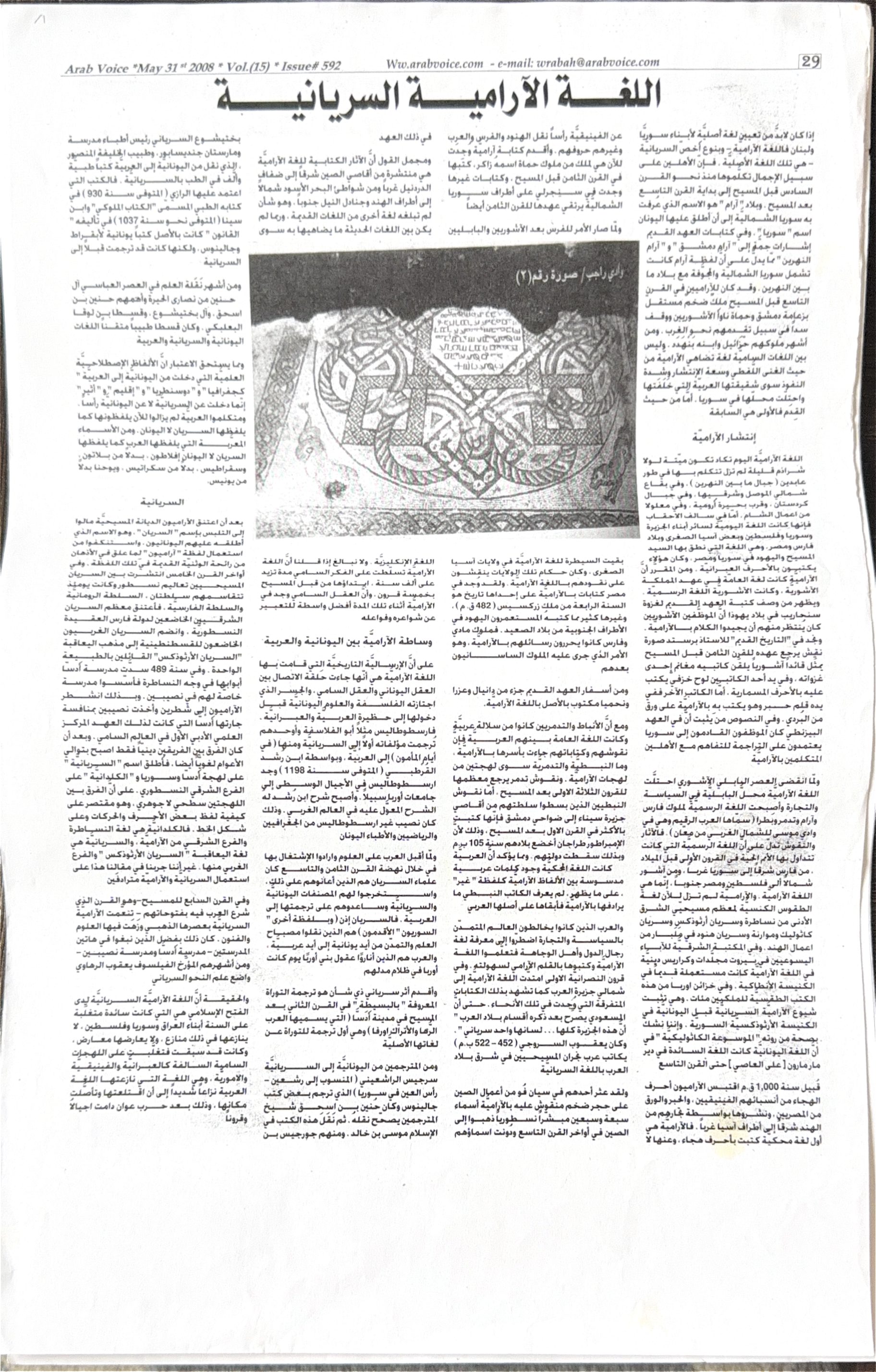
اللغة الآراميّة اليوم تكاد تكون ميّتة لولا شراذم قليلة لم تزل تتكلم بها في طور عابدين (جبال ما بين النهرين). وفي بقاع شمالي الموصل وشرقيها، وفي جبال كردستان، وقرب بحيرة أرومية، وفي معلولا من اعمال الشام. أما في سالف الأحقاب فإنها كانت اللغة اليومية لسائر أبناء الجزيرة وسوريا وفلسطين وبعض آسيا الصغرى وبلاد فارس ومصر. وهي اللغة التي نطق بها السيد المسيح واليهود في سوريا ومصر، وكان هؤلاء يكتبون بالأحرف العبرانية. ومن المقرر أن الآرامية كانت لغة العامة في عهد المملكة الآشورية، وكانت الآشورية اللغة الرسمية. ويظهر من وصف كتبة العهد القديم لغزوة سنحاريب في بلاد يهوذا أن الموظفين الآشوريين كان ينتظر منهم أن يجيدوا الكلام بالآرامية. وجد في "التاريخ القديم" للاستاذ برستد صورة نقش يرجع عهده للقرن الثامن قبل المسيح يمثل قائدا آشوريا يلقن كاتبيه مغانم إحدى غزواته. وفي يد أحد الكاتبين لوح خزفي يكتب عليه بالأحرف المسمارية. أما الكاتب الآخر ففي يده قلم حبر وهو يكتب به بالآرامية على ورق من البردي. وفي النصوص من يثبت أن في العهد البيزنطي كان الموظفون القادمون إلى سوريا يعتمدون على التراجمة للتفاهم مع الأهلين المتكلمين بالآرامية
ولمّا انقضى العصر البابلي الآشوري احتلَّت اللغة الآرامية محل البابلية في السياسة والتجارة وأصبحت اللغة الرسمية لملوك فارس وآرام وتدمر وبطرا (سماها العرب الرقيم وهي في وادي موسى للشمال الغربي من معان). فالآثار والنقوش تدل على أن اللغة الرسمية التي كانت تتداول بها الأمم الحية في القرون الأولى قبل الميلاد، من فارس شرقا إلى سوريا غربا، ومن آشور شمالا إلى فلسطين ومصر جنوبا، إنما هي اللغة الآرامية. والآرامية لم تزل للآن لغة الطقوس الكنسية لمعظم مسيحيي الشرق الأدنى من نساطرة وسريان أرثوذكس وسريان كاثوليك وموارنة وسريان هنود في مليبار من اعمال الهند. وفي المكتبة الشرقية للآباء اليسوعيين في بيروت مجلدات وكراريس دينية في اللغة الآرامية كانت مستعملة قديما في الكنيسة الأنطاكية. وفي خزائن اوربا من هذه الكتب الطقسية للملكيين مئات. وهي تثبت شيوع الآرامية السريانية قبل اليونانية في الكنيسة الأرثوذكسية السورية. وإننا نشك بصحة من روته "الموسوعة الكاثوليكية" في أن اللغة اليونانية كانت اللغة السائدة في دير مارمارون [على العاصي] حتى القرن التاسع
قُبيل سنة 1,000 ق.م اقتبس الآراميون أحرف الهجاء من أنسبائهم الفينيقيين، والحبر والورق من المصريين، ونشروها بواسطة تجارهم من الهند شرقا إلى أطراف آسيا غربا. فالآرامية هي أول لغة محكية كتبت بأحرف هجاء، وعنها لا عن الفينيقيّة رأسا نقل الهنود والفرس والعرب وغيرهم حروفهم. وأقدم كتابة آرامية وجدت للآن هي لملك من ملوك حماة اسمه زاكر، كتبها في القرن الثامن قبل المسيح. وكتابات غيرها وجدت في سنجرلي على أطراف سوريا الشمالية يرتقي عهدها للقرن الثامن أيضا
ولمّا صار الأمر للفرس بعد الآشوريين والبابليين بقيت السيطرة للغة الآراميَّة في ولايات آسيا الصغرى. وكان حكام تلك الولايات ينقشون على نقودهم باللغة الآرامية. ولقد وجد في مصر كتابات بالآرامية على إحداها تاريخ هو السنة الرابعة من ملك زركسيس (482 ق.م)، وغيرها كثير ما كتبه المستعمرون اليهود في الأطراف الجنوبية من بلاد الصعيد. فملوك مادي وفارس كانوا يحررون رسائلهم بالآرامية، وهو الأمر الذي جرى عليه الملوك الساسانيون بعدهم
ومن أسفار العهد القديم جزء من دانيال وعزرا ونحميا مكتوب بالأصل باللغة الآرامية.
ومع أنَّ الأنباط والتدمريين كانوا من سلالة عربية وكانت اللغة العامة بينهم العربية فإن نقوشهم وكتاباتهم جاءت بأسرها بالآرامية. وما النبطية والتدمرية سوى لهجتين من لهجات الآرامية. ونقوش تدمر يرجع معظمها للقرون الثلاثة الاولى بعد المسيح. أما نقوش النبطيين الذين بسطوا سلطتهم من أقاصي جزيرة سيناء إلى ضواحي دمشق فإنها كتبت بالأكثر في القرن الاول بعد المسيح، وذلك لأن الإمبراطور طراجان أخضع بلادهم سنة 105 ب.م وبذلك سقطت دولتهم. وما يؤكد أن العربية كانت اللغة المحكية وجود كلمات عربية مدسوسة بين الألفاظ الآرامية كلفظة "غير"، على ما يظهر، لم يعرف الكاتب النبطي ما يرادفها بالآرامية فأبقاها على أصلها العربي
والعرب الذين كانوا يخالطون العالم المتمدّن بالسياسة والتجارة اضطروا إلى معرفة لغة رجال الدول وأهل الوجاهة فتعلموا اللغة الآرامية وكتبوها بالقلم الآرامي لسهولته. وفي قرون النصرانية الاولى امتدت اللغة الآرامية إلى شمالي جزيرة العرب كما تشهد بذلك الكتابات المتفرقة التي وُجدت في تلك الأنحاء. حتى أن المسعودي يصرح بعد ذكره أقسام بلاد العرب "أن هذه الجزيرة كلها ... لسانها واحد سرياني". وكان يعقوب السروجي (452 - 522 ب.م) يكاتب عرب نجران المسيحيين في شرق بلاد العرب باللغة السريانية
ولقد عثر أحدهم في سيان فُو من أعمال الصين على حجر ضخم منقوش عليه بالآرامية أسماء سبعة وسبعين مبشرا نسطوريا ذهبوا إلى الصين في أواخر القرن التاسع ودونت اسماؤهم في ذلك العهد
ومجمل القول أنَّ الآثار الكتابية للغة الآراميّة هي منتشرة من أقاصي الصين شرقا إلى ضفاف الدردنيل غربا ومن شواطئ البحر الأسود شمالا إلى أطراف الهند وجنادل النيل جنوبا. وهو شأن لم تبلغه لغة أخرى من اللغات القديمة، وربما لم يكن بين اللغات الحديثة ما يضاهيها به سوى اللغة الإنكليزيّة. ولا نبالغ إذا قلنا أنَّ اللغة الآرامية تسلطت على الفكر السامي مدة تزيد على ألف سنة، ابتداؤها من قبل المسيح بخميسة قرون. وأن العقل السامي وجد في الآرامية أثناء تلك المدة أفضل واسطة للتعبير عن شواعره وفواعله
وساطة الآراميَّة بين اليونانية والعربية
على أنَّ الإرساليَّة التاريخيَّة التي قامت بها اللغة الآرامية هي أنها جاءت حلقة الاتصال بين العقل اليوناني والعقل السامي، والجسر الذي اجتازته الفلسفة والعلوم اليونانية قبيل دخولها إلى حظيرة العربية والعبرانية. فارسطوطاليس مثلا أبو الفلاسفة وأوحدهم ترجمت مؤلفاته أولا إلى السريانية ومنها (في أيام المأمون) إلى العربية، وبواسطة ابن رشد القرطبي (المتوفى سنة 1198) وجد ارسطوطاليس في الأجيال الوسطى إلى جامعات أوربا سبيلا. وأصبح شرح ابن رشد له الشرح المعول عليه في العالم الغربي. وذلك كان نصيب غير ارسطوطاليس من الجغرافيين والرياضيين والأطباء اليونان
ولمّا أقبل العرب على العلوم وارادوا الإشتغال بها في خلال نهضة القرن الثامن والتاسع كان علماء السريان هم الذين أعانوهم على ذلك. واستخرجوا لهم المصنفات اليونانية والسريانية وساعدوهم على ترجمتها إلى العربية. فالسريان إذن (وبلفظة أخرى "السوريون" الأقدمون) هم الذين نقلوا مصباح العلم والتمدن من أيد يونانية إلى أيد عربية، والعرب هم الذين أناروا عقول بني أوربّا يوم كانت أوربا في ظلام مدلهم
وأقدم أثر سرياني ذي شأن هو ترجمة التوراة المعروفة "بالبسيطة" في القرن الثاني بعد المسيح في مدينة أدسا (التي يسميها العرب الرها والأتراك اورفا) وهي أول ترجمة للتوراة عن لغاتها الأصلية
ومن المترجمين من اليونانية إلى السريانية سرجيس الراشعيني (المنسوب إلى رشعين - رأس العين في سوريا) الذي ترجم بعض كتب جالينوس وكان حنين بن اسحق شيخ المترجمين يصحح نقله. ثم نقل هذه الكتب في الإسلام موسى بن خالد. ومنهم جورجيس بن بختيشوع السرياني رئيس أطباء مدرسة ومارستان جنديسابور، وطبيب الخليفة المنصور، الذي نقل من اليونانية إلى العربية كتبا طبية وألف في الطب بالسريانية. فالكتب التي اعتمد عليها الرازي (المتوفى سنة 930) في كتابه الطبي المسمى "الكتاب الملوكي" وابن سينا (المتوفى نحو سنة 1037) في تأليفه "القانون" كانت بالأصل كتبا يونانية لأبقراط وجالينوس، ولكنها كانت قد ترجمت قبلا إلى السريانية
ومن أشهر نقلة العلم في العصر العباسي آل حنين من نصارى الحيرة وأهمهم حنين بن اسحق، وآل بختيشوع، وقسطا بن لوقا البعلبكي. وكان قسطا طبيبا متقنا اللغات اليونانية والسريانية والعربية
ومما يستحق الاعتبار انَّ الألفاظ الإصطلاحيّة العلمية التي دخلت من اليونانية إلى العربية "كجغرافيا" و"دوسنطريا" و"إقليم" و"أثير" إنما دخلت عن السريانية لا عن اليونانية رأسا. ومتكلموا العربية لم يزالوا للآن يلفظونها كما يلفظها السريان لا اليونان. ومن الأسماء المعربة التي يلفظها العرب كما يلفظها السريان لا اليونان إفلاطون، بدلا من بلاتون وسقراطيس، بدلا من سكراتيس، ويوحنا بدلا من يونيس.
السريانية
بعد أن اعتنق الآراميون الديانة المسيحيّة مالوا إلى التلبس بإسم "السريان"، وهو الاسم الذي أطلقه عليهم اليونانيون. واستنكفوا من استعمال لفظة "آراميون" لما علق في الأذهان من رائحة الوثنية القديمة في تلك اللفظة. وفي أواخر القرن الخامس انتشرت بين السريان المسيحيين تعاليم نسطور وكانت يومئذ تتقاسمهم سلطتان، السلطة الرومانية والسلطة الفارسية. فأعتنق معظم السريان الشرقيين الخاضعين لدولة فارس العقيدة النسطورية. وانضم السريان الغربيون الخاضعون للقسطنطينية إلى مذهب اليعاقبة "السريان الأرثوذكس" القائلين بالطبيعة الواحدة. وفي سنة 489 سدت مدرسة أدسا أبوابها في وجه النساطرة فأسسوا مدرسة خاصة لهم في نصيبين. وبذلك انشطر الآراميون إلى شطرين وأخذت نصيبين منافسة جارتها أدسا التي كانت لذلك العهد المركز العلمي الأدبي الأول في العالم السامي. وبعد أن كان الفرق بين الفريقين دينيا فقط اصبح بتوالي الأعوام لغويا أيضا. فأطلق اسم "السريانية" على لهجة أدسا وسوريا و"الكلدانية" على الفرع الشرقي النسطوري. على أن الفرق بين اللهجتين سطحي لا جوهري، وهو مقتصر على كيفية لفظ بعض الأحرف والحركات وعلى شكل الخط. فالكلدانية هي لغة النساطرة والفرع الشرقي من الآرامية، والسريانية هي لغة اليعاقبة "السريان الأرثوذكس" والفرع الغربي منها. غير أننا جرينا في مقالنا هذا على استعمال السريانية والآرامية مترادفين
وفي القرن السابع للمسيح - وهو القرن الذي شرع العرب فيه بفتوحاتهم - تنعمت الآرامية السريانية بعصرها الذهبي وزهت فيها العلوم والفنون. كان ذلك بفضل الذين نبغوا في هاتين المدرستين - مدرسة أدسا ومدرسة نصيبين - ومن أشهرهم المؤرخ الفيلسوف يعقوب الرهاوي واضع علم النحو السرياني
والحقيقة أنَّ اللغة الآراميّة السريانيّة لدى الفتح الإسلامي هي التي كانت سائدة متغلبة على السنة أبناء العراق وسوريا وفلسطين، لا ينازعها في ذلك منازع، ولا يعارضها معارض، وكانت قد سبقت فتغلبت على اللهجات السامية السالفة كالعبرانية والفينيقية والامورية، وهي اللغة التي نازعتها اللغة العربية نزاعا شديدا إلى أن اقتلعتها وتأصلت مكانها، وذلك بعد حرب عوان دامت اجيالا وقرونا
If one must designate an original language for the people of Syria and Lebanon, then Aramaic — and Syriac in particular — is that original language. For the inhabitants, broadly speaking, spoke it from about the sixth century before Christ until the beginning of the ninth century after Christ. "Aram" is the name by which northern Syria was known until the Greeks called it "Syria." In the writings of the Old Testament there are numerous references to "Aram of Damascus" and "Aram of the Two Rivers" (Aram-Naharaim), which indicates that the term Aram encompassed northern and hollow Syria together with Mesopotamia. In the ninth century before Christ the Arameans had a great independent kingdom led by Damascus and Hama, which opposed the Assyrians and stood as a barrier against their advance toward the West. Among their most famous kings were Hazael and his son Ben-Hadad. Among the Semitic [sic] languages there is none to rival Aramaic in richness of vocabulary[?], breadth of diffusion, and strength of influence, save its sister Arabic, which succeeded it and took its place in Syria. As for antiquity, the former is the earlier.
The Spread of Aramaic
Aramaic today is all but dead, but for a few scattered groups that still speak it in Tur Abdin (the mountains of Mesopotamia), in the regions north and east of Mosul, in the mountains of Kurdistan, near Lake Urmia, and in Maalula in the district of Damascus. But in ages past it was the everyday language of all the people of the Jazira, Syria, Palestine, part of Asia Minor, Persia, and Egypt. It is the language spoken by the Lord Christ and by the Jews in Syria and Egypt, and these latter used to write it in Hebrew characters. It is established that Aramaic was the language of the common people in the era of the Assyrian kingdom, while Assyrian was the official language. It appears from the description by the writers of the Old Testament of Sennacherib's invasion of the land of Judah that Assyrian officials were expected to be fluent in speaking Aramaic. In Professor Breasted's "Ancient Times" there is a picture of an inscription dating to the eighth century before Christ, depicting an Assyrian commander dictating to his scribes the spoils of one of his campaigns. In the hand of one of the scribes is a clay tablet on which he writes in cuneiform characters. As for the other scribe, in his hand is an ink pen, and with it he writes in Aramaic on papyrus. Among the texts is what confirms [sic] that in the Byzantine era the officials who came to Syria relied on interpreters in order to communicate with the inhabitants, who spoke Aramaic.
When the Babylonian-Assyrian age passed, the Aramaic language took the place of Babylonian in politics and commerce and became the official language of the kings of Persia, Aram, Palmyra, and Petra (which the Arabs called al-Raqim; it lies in Wadi Musa to the northwest of Maan). The monuments and inscriptions show that the official language current among the living nations in the first centuries before the Christian era — from Persia in the east to Syria in the west, and from Assyria in the north to Palestine and Egypt in the south — was none other than Aramaic. Aramaic remains to this day the liturgical language of most of the Christians of the Near East: Nestorians, Syriac Orthodox, Syriac Catholics, Maronites, and Indian Syriacs in Malabar in the region of India. In the Bibliothèque Orientale of the Jesuit Fathers in Beirut there are volumes and religious booklets in the Aramaic language that were used of old in the Antiochene Church. In the treasuries of Europe there are hundreds of these liturgical books belonging to the Melkites. They prove the prevalence of Aramaic-Syriac before Greek in the Syrian Orthodox Church. We doubt the accuracy of what the "Catholic Encyclopedia" recounted, namely that Greek was the prevailing language in the monastery of Mar Maroun [on the Orontes] until the ninth century.
Shortly before the year 1000 BC the Arameans borrowed the letters of the alphabet from their kin the Phoenicians, and ink and paper from the Egyptians, and spread them by means of their merchants from India in the east to the edges of Asia in the west. Aramaic is thus the first spoken language written in alphabetic letters, and it was from it — not directly from Phoenician — that the Indians, Persians, Arabs, and others took their letters. The oldest Aramaic writing found to date belongs to one of the kings of Hama named Zakir, who wrote it in the eighth century before Christ. Other writings were found at Zincirli on the edges of northern Syria, dating likewise to the eighth century.
When rule passed to the Persians after the Assyrians and Babylonians, Aramaic retained its dominance in the provinces of Asia Minor. The governors of those provinces would engrave their coins in the Aramaic language. Writings in Aramaic were found in Egypt, one of them bearing a date that is the fourth year of the reign of Xerxes (482 BC), and much else besides that was written by the Jewish colonists in the southern reaches of Upper Egypt. The kings of Media and Persia would compose their letters in Aramaic, a practice the Sasanian kings after them continued to follow.
Among the books of the Old Testament, part of Daniel, and Ezra and Nehemiah, were originally written in the Aramaic language.
Although the Nabateans and Palmyrenes were of Arab stock and the common language among them was Arabic, their inscriptions and writings came entirely in Aramaic. Nabatean and Palmyrene are but two dialects among the dialects of Aramaic. The inscriptions of Palmyra date for the most part to the first three centuries after Christ. As for the inscriptions of the Nabateans, who extended their authority from the far reaches of the Sinai Peninsula to the outskirts of Damascus, they were written mostly in the first century after Christ, because the Emperor Trajan subdued their country in the year 105 AD and thereby their state fell. What confirms that Arabic was the spoken language is the presence of Arabic words inserted among the Aramaic terms, such as the word "ghayr" ("other than"); apparently the Nabatean scribe did not know its equivalent in Aramaic and so kept it in its original Arabic form.
The Arabs, who mingled with the civilized world through politics and commerce, were compelled to learn the language of statesmen and men of standing, and so they learned the Aramaic language and wrote it in the Aramaic script because of its ease. In the early centuries of Christianity, Aramaic extended to the north of the Arabian Peninsula, as attested by the scattered writings found in those regions — so much so that al-Masudi declares, after mentioning the divisions of the land of the Arabs, "that this whole peninsula … has one tongue, Syriac." And Jacob of Sarug (452–522 AD) used to correspond with the Christian Arabs of Najran in eastern Arabia in the Syriac language.
Someone found at Xi'an-fu in China a huge stone inscribed in Aramaic with the names of seventy-seven Nestorian missionaries who went to China in the late ninth century, and their names were recorded at that time.
In sum, the written remains of the Aramaic language are spread from the far reaches of China in the east to the shores of the Dardanelles in the west, and from the coasts of the Black Sea in the north to the borders of India and the cataracts of the Nile in the south. This is a distinction no other ancient language attained, and perhaps among the modern languages there is none to rival it in this save English. We do not exaggerate if we say that the Aramaic language held sway over the Semitic mind for a period exceeding a thousand years, beginning five centuries before Christ, and that the Semitic mind found in Aramaic, during that period, the finest means of expressing its feelings and its acts.
The Mediation of Aramaic Between Greek and Arabic
Yet the historic mission that the Aramaic language performed is that it came to be the link between the Greek mind and the Semitic mind, and the bridge that Greek philosophy and the sciences crossed before entering the fold of Arabic and Hebrew. Aristotle, for example, the father of philosophers and their peerless one — his works were first translated into Syriac, and from it (in the days of al-Mamun) into Arabic; and through Ibn Rushd (Averroes) of Cordoba (died in the year 1198) Aristotle found, in the Middle Ages, a path to the universities of Europe. Ibn Rushd's commentary on him became the authoritative commentary in the Western world. And such was the lot of others besides Aristotle among the Greek geographers, mathematicians, and physicians.
When the Arabs turned to the sciences and sought to occupy themselves with them during the renaissance of the eighth and ninth centuries, it was the Syriac scholars who assisted them in that. They brought out for them the Greek and Syriac compositions and helped them translate them into Arabic. The Syriacs, then (in other terms, the ancient "Syrians"), are the ones who carried the lamp of learning and civilization from Greek hands to Arab hands, and the Arabs are the ones who illumined the minds of the people of Europe on the day when Europe was in murky darkness.
The oldest Syriac work of importance is the translation of the Bible known as the "Peshitta," made in the second century after Christ in the city of Edessa (which the Arabs call al-Ruha and the Turks Urfa); it is the first translation of the Bible from its original languages.
Among the translators from Greek into Syriac was Sergius of Reshaina (attributed to Reshaina — Ras al-Ayn in Syria), who translated some of the books of Galen, and Hunayn ibn Ishaq, the dean of translators, would correct his rendering. Then, under Islam, these books were translated by Musa ibn Khalid. Among them too was George (Jurjis) ibn Bakhtishu the Syriac, head physician of the school and hospital of Gundeshapur, and physician to the Caliph al-Mansur, who translated medical books from Greek into Arabic and composed works on medicine in Syriac. The books that al-Razi (died in the year 930) relied upon in his medical work titled "al-Kitab al-Muluki" (the Royal Book), and that Ibn Sina (Avicenna, died about the year 1037) relied upon in his composition "al-Qanun" (the Canon), were originally Greek books by Hippocrates and Galen, but they had earlier been translated into Syriac.
Among the most famous transmitters of learning in the Abbasid era were the family of Hunayn, from the Christians of al-Hira, chief among them Hunayn ibn Ishaq, and the family of Bakhtishu, and Qusta ibn Luqa of Baalbek. Qusta was a physician proficient in the Greek, Syriac, and Arabic languages.
Worthy of consideration is that the technical scientific terms that entered Arabic from Greek — such as "geography," "dysentery," "iqlim" (clime), and "ether" — entered by way of Syriac, not directly from Greek. And speakers of Arabic to this day still pronounce them as the Syriacs pronounce them, not as the Greeks. Among the Arabized names that the Arabs pronounce as the Syriacs pronounce them, not as the Greeks, are Aflatun (instead of Platon), Suqrat (instead of Socrates), and Yuhanna (instead of Ioannes).
Syriac
After the Arameans embraced the Christian religion, they inclined to take on the name "Syriacs," the name the Greeks had applied to them. They shrank from using the term "Arameans" because of the odor of the ancient paganism that clung in people's minds to that term. In the late fifth century the teachings of Nestorius spread among the Christian Syriacs, who at that time were divided between two authorities, the Roman authority and the Persian authority. So most of the eastern Syriacs, subject to the Persian state, embraced the Nestorian creed, while the western Syriacs, subject to Constantinople, joined the doctrine of the Jacobites, "the Syriac Orthodox," who profess the single nature. In the year 489 the school of Edessa closed its doors in the face of the Nestorians, so they founded a school of their own in Nisibis. Thereby the Arameans split into two halves, and Nisibis began to rival its neighbor Edessa, which was in that age the foremost scholarly and literary center in the Semitic world. And after the difference between the two parties had been religious only, it became with the passing of the years linguistic as well. So the name "Syriac" was applied to the dialect of Edessa and Syria, and "Chaldean" to the eastern Nestorian branch. Yet the difference between the two dialects is superficial, not essential, and is confined to the manner of pronouncing certain letters and vowels and to the form of the script. Chaldean is the language of the Nestorians and the eastern branch of Aramaic, and Syriac is the language of the Jacobites, "the Syriac Orthodox," and the western branch of it. However, in this article of ours we have proceeded to use Syriac and Aramaic as synonyms.
In the seventh century after Christ — the century in which the Arabs began their conquests — Aramaic-Syriac enjoyed its golden age, and the sciences and arts flourished in it. That was thanks to those who distinguished themselves in these two schools — the school of Edessa and the school of Nisibis — among the most famous of whom was the historian and philosopher Jacob of Edessa, founder of the science of Syriac grammar.
The truth is that the Aramaic-Syriac language, at the time of the Islamic conquest, was the one prevailing and dominant on the tongues of the people of Iraq, Syria, and Palestine, with no rival contesting it and no opponent opposing it. It had preceded and prevailed over the earlier Semitic dialects such as Hebrew, Phoenician, and Amorite, and it is the language that Arabic contested fiercely until it uprooted it and became rooted in its place — that after a bitter war that lasted generations and centuries.
اضغط على الصورة لفتحها بالحجم الكامل